Much of India today is made up of unimaginative and uninspired structures that are passed off as “architecture”. This in itself is an irony, considering our subcontinent is home to some of the most magnificent structures of the past. These were not just beautiful; they pushed the very idea of architecture and construction. More importantly, they used space to create a spiritual experience on a subconscious level.
According to Natyashastra, architecture is an art form that uses elements of space, ornamentation and natural elements to create rasa bhaava. One of the finest examples of this, to my mind, is the Ellora caves complex. The Ellora Caves evolved between the 6th and 10th centuries. Commissioned by various kings from the Rashtrakuta and Yadava dynasties, they are a testimony to the coexistence of multiple religious beliefs in India. Besides the monolith architectural marvel that is the Kailasa temple, the Ellora caves are home to some of the most fascinating Jain and Buddhist cave temples, monasteries and meditation halls, all cut into the rock formations that are present in the area.
It was on an early June morning when I, along with two fellow artists, made our way to the Ellora caves temple complex. The first rays of the sun were touching the tip of the kalash of the Kailasa temple while the fallen champa flowers filled the early morning air with promise and a sense of peace. Devotees in their crisp white dhotis prostrated themselves before the temple to pray to the rising sun, even as young fitness enthusiasts in their jogging attire took advantage of the well laid out paths in the massive temple-cave complex.
I suddenly realised that this place, which I had revered since my student days as an epitome of art, imagination and human audacity, was very much a living site! We then set off towards the Jain caves. The quiet, winding path surrounded by a lush green forest with gentle meandering brooks and small waterfalls made for a walk that would be etched in our memory for a long time. Soon, we approached cave 33, also known as Jagannatha Sabha.
One of the largest Jain caves in Ellora, Jagannatha Sabha dates to the 9th century. The two-storeyed cave houses ancient Tirthankara stories depicted through frescoes and sculptures. Being an artist, and having another member of our group who belonged to the Jain community, gave us different perspectives to appreciate the beauty of the ancient frescoes. As we entered the main entrance, we stepped into a courtyard with a temple in the centre. Walking around it, we reached the prayer area.
The garbhagriha houses remarkably well preserved frescoes depicting the 11th Tirthankar in bold shades of reds and greens. The interiors are in complete darkness, and one wonders whether this might have helped preserve these magnificent frescoes in their original form.
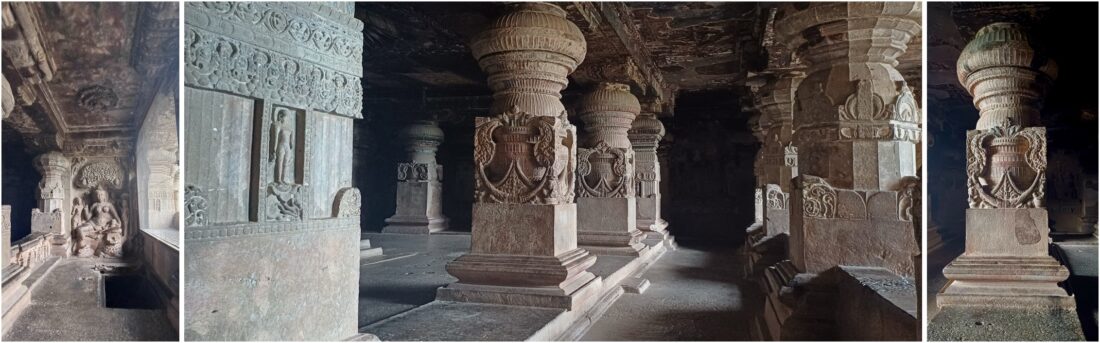
A garbhagriha, for the uninitiated, is the innermost chamber in a temple. The word garbha comes from the Sanskrit word for womb, and griha is the Sanskrit word for house. In the context of Indian temple architecture, it refers to the idea of a “cosmic womb” – the birthplace of the cosmos and of all existence. This is the chamber in a temple where the deity is housed.
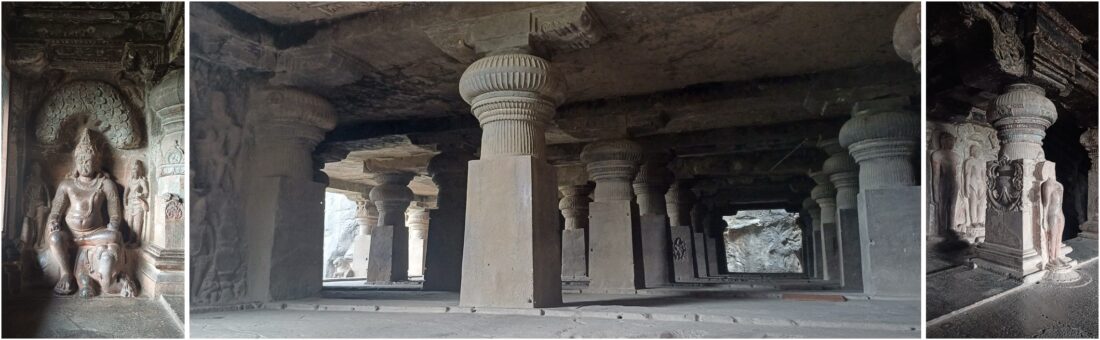
The ceiling of the mandapa, depicts the stories of the blind queen and other symbols from Jain teachings. The mandapa is the area outside or in front of the garbhagriha where people gather to pray or conduct yagnas. Cave 33’s mandapa walls are adorned with images of Mahavir, Parsvanath and Gomta from the Jain sect. The figures are made in elegant lines and with a sophistication that only comes with an extremely evolved understanding of the craft and subject. Its refined carvings spoke of a skill and expertise beyond comprehension. Looking at these perfect sculptures, it made me wonder about the years of practice the artist must have undertaken before being allowed to work on the caves, and where were these practice pieces to be found!
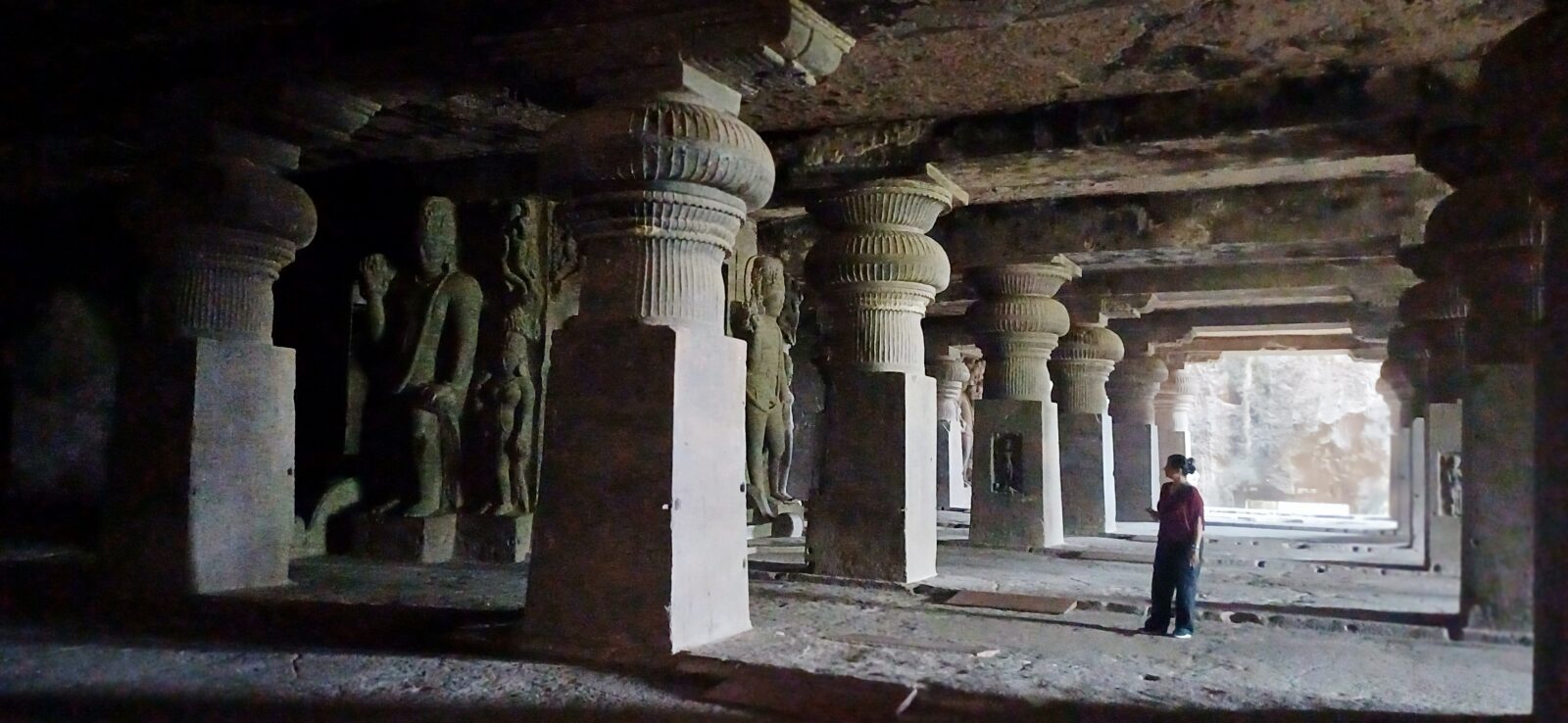
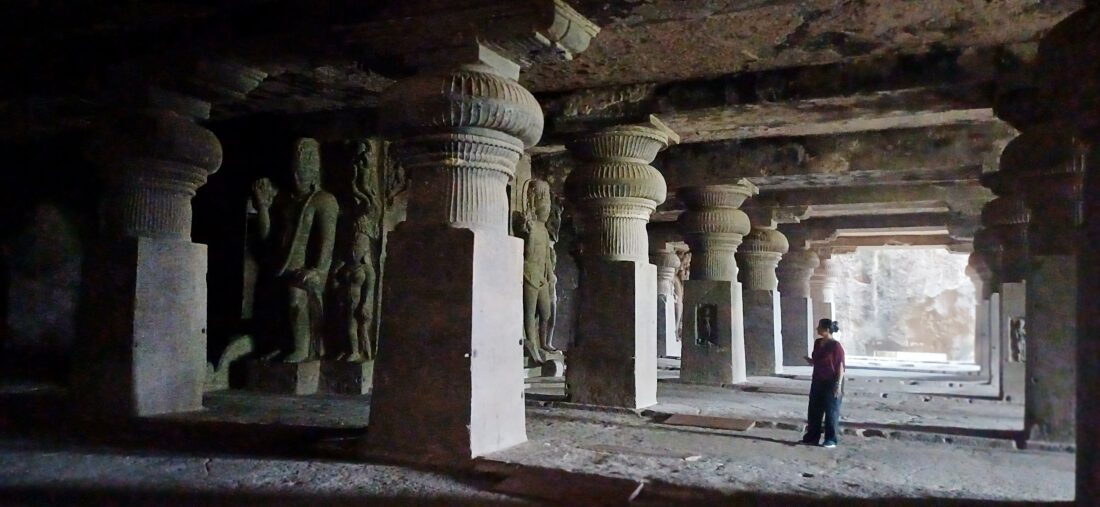
The first floor of the cave holds magnificent, larger-than-life relief sculptures of yaksha and yakshi, but what caught my attention the most was the unusual design of the pillars. The layered carvings on the pillars, depicting draped cloth along with floral motifs and ribbed multiple-layered top, exhibit immense expertise. It’s almost like the sculptors are showing off their skill with a cool confidence and panache! The flourish of the pillars juxtaposed with the clean and elegant lines of the Jain figures around the columns, seem to highlight the act of renouncing worldly temptations.
It was an inspiring start to the day to witness the exquisite beauty created centuries ago. The size and scale of the cave and the sculptures within, left a sense of being one with our surroundings. It felt like we were occupying the remaining negative space to complete the sculptures around us – the viewer and the viewed as one.
Moving onward to cave 29, we decided to take a short-cut and walked through a narrow cemented path surrounded by fresh green grass. The path was slightly elevated and beyond the trees, one could see hints of the town. The exterior of cave 29 certainly did not prepare us for what lay within. Dedicated to Lord Shiva, this rock-cut Ellora cave is also known as Sita ki Nahani. The first thing that struck me as I stepped into the cave was the sheer scale of its interiors. How is it even possible to achieve such a feat in cave architecture I wondered!

Dating back to the 6th century, it’s in stark contrast to cave 33. Perhaps it’s the immediate juxtaposition of these scales that adds to the awe inspiring magnitude of its space. Where cave 33 has a lower ceiling, the height of cave 29 is approximately 18 ft. The scale of the sculptures is designed to fill you with awe and make you realise how small and insignificant humans are in the grander scheme of things. The clean lines of the pillars and their height accentuates the austere and simple aesthetics.
Upon stepping into the cave, I saw a beautiful larger than life depiction of Ravan lifting Mount Kailash on the right wall. The classical and sophisticated depiction of the human form with economical and elegant lines is a theme that runs through all the sculptures in the cave. As you walk deeper into the cave, you can see that the natural formation of the structure gives it the most unique ambience. There’s a natural opening in the left wing through which the morning light filters in, thereby adding mystery to the already awe inspiring interiors.
If gazing in wonder at the mystical light beam falling on the lion’s head wasn’t enough to set the mood, it began to drizzle. A soft natural light filled the cave and its right wing opened up to a horse-shoe shaped valley where the lush green landscape of Maharashtra was in its full monsoon glory. We could see a narrow path going down to a cluster of caves with many small waterfalls covering their opening. Of course, we immediately wanted to walk down to the cluster to see the interesting amalgamation of nature and structure, but the locked door forced us to stop our exploration from going any further. So, we walked back to the end of the central axis to the garbhagriha.
The shivling exuded an omnipresent energy that filled you with an awareness of the vastness and all-pervading divine energy. That is the power of architecture – it can make you experience the spiritual by creating an awareness of the self. Whether it be through the Jain philosophy of being one with the world and therefore not hurting any life form, or through making you aware of your own insignificance in this vast cosmos.
That June morning, I had walked into the Ellora temple cave complex to look at art and perhaps enjoy the stories depicted in its caves, but what I came back with was an acute spiritual experience – an awakening of the senses. It renewed my awe and admiration for this magnificent group of cave temples, forever imprinting them on my mind.

Malvika Mankotia
Malvika Mankotia is a versatile artist having earned her B.V.A. and M.V.A. from the Faculty of Fine Art, M.S. University, Vadodara. Her work has been featured in prominent national and international exhibitions, including the International Watercolor Festival in Italy (2024) and the Confluence Awadh Art Festival in New Delhi (2022). A recipient of the silver medal at the National Art & Science Exhibition (2021), she has also participated in numerous residencies and workshops, contributing to the art community . Her artistic journey is marked by experimentation, community engagement, and a commitment to creating impactful work.
Wow! Such a beautiful description of the design and architecture. I have never been to the Ellora caves but now I know I must visit. Kudos Malvika!