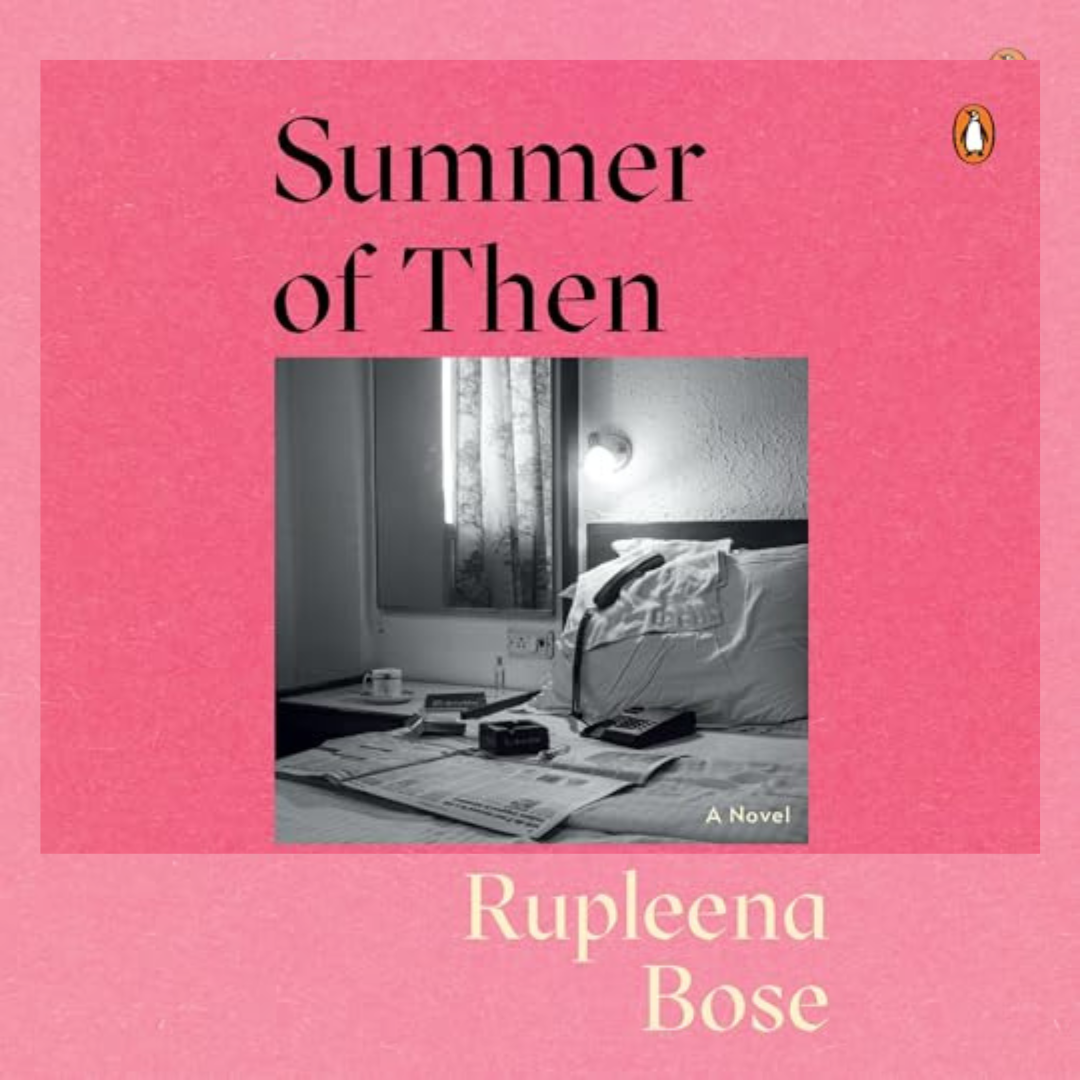
” Where do people go when they leave? I grew up with the story of leaving. A leaving nobody had the answer to.”
Bose’s evocative novel opens with a heartfelt tribute to her grandmother, a gifted storyteller whose influence shapes this narrative. This narrative is about womanhood, the subtle yet palpable intricacies, and a constant wavering between restraint and desire.
The novel starts with an unnamed female protagonist standing on the stairs of an old building with her boyfriend, Nikhil, visiting his friend, Zap. The opening scene of the book is no less than a poem where she describes the city as a smokeless city, where the sky is full of stars, and there is a faint fragrance of flowers.
In the first half of the book, she and Zap feel this instant attraction, the pull towards each other, the undercurrent of their buzzing chemistry could be seen and felt. As a reader, the anticipation of what happens next engulfs you from the start, the sensation is nail- biting and thrilling. They both dance around the lines of morality and immorality without taking any risks, always in two minds whether to act upon or not.
The second half of the novel provides the canvas for the readers to pick sides; it’s open to speculation, and for some, it’s open to judgment as well because what she does is really smooth and bold at the same time. She and Zap were inevitable, but so were she and Nikhil.
I loved how Bose, with her prose, beautifully, poetically and intricately enmeshed all of their lives together only to be unwound later. To understand our unnamed female protagonist, we must look into her background because what happens when you’re born in an Indian middle-class family with no luxuries, just the basics, and you know you’ll survive on the scholarships. You’re taught morals but along with it you’re also taught the art of silence, you’re not believed when you raise your voice against the wrong, you’re asked to keep quiet and somehow that becomes your entire personality.
Undoubtedly the protagonist in this book is a woman of contradictions, she’s not submissive but she holds back her opinions because she knows that it won’t matter, she’s strong but also a bit broken, she wants, she desires but doesn’t ask for any of it. She believes in things that matter, in morals, until she doesn’t. She is a bit of a recluse who lives her life in an unconditional manner. She’s a writer who sees beauty in what’s broken, in the cracks and in the misdemeanour.
Bose’s writing is exquisite – lyrical, layered and deeply affecting. Beyond the female lead, the cities of Calcutta, Delhi and Edinburgh are rendered as characters themselves, each with its own arc. The book also explores the themes of friendships, the shifting political landscape in the country, the rise of politics in academia and art as a means of resistance and revolution.
The protagonist in the book is a Literature Professor; the book revolves mainly around her growth (along with her personal life, which plays the second lead in the book), and her upward career trajectory. Her growth from an ad-hoc to a professor, from an unaccomplished writer to an accomplished one, marked by the bold choices she makes along her life.”
The story felt relevant in today’s time because in the postmodern era, we are far more complex than we appear; we are made up of feelings which were once deemed forbidden yet demand acknowledgement.
The protagonist in her story is holding our hands, taking us places, narrating her story, through whatever happened, and however it happened, so that we can decide for ourselves where we stand. Do we take the moral high ground, do we discard her, or do we choose to understand her, for she represents the grey areas residing in all of us?
She raises the questions, if it’s possible to love two men at the same time, what happens when you don’t speak when you wanted to but still chose not to, it’s about the choices she made which took her to places, the lingering feeling of emptiness, the impending void, the longing, how she feels to live in the grey between moral and immoral, her never ending search for love and belonging.
And in the end, she makes us ask the final question: “ain’t belonging only a dream when you’re born in a family with the history of leaving & you question where do people go when they leave?”
Ankita Mishra
I’m Ankita Mishra, a law postgraduate whose intellectual curiosity extends far beyond the courtroom. An avid reader with an enduring passion for literature, I find solace and inspiration in the pages of novels and short stories. My literary tastes gravitate towards the dark and introspective corners of fiction, where themes of love, loss, and longing unfold with haunting beauty. Drawn especially to themes of unrequited love and emotional depth, I try to explore the human psyche through the lens of timeless authors and complex characters. What began as a simple hobby has, over time, culminated in a passion; from reading books to reviewing, leading to a bookstagram account. My dual interests in law and literature probably reflect a mind attuned to both justice and emotion—analytical yet deeply empathetic, logical yet poetic.