It was a given that I was going to sign-up when I saw the post for the Pinjore Heritage Walk on my bookclub’s whatsapp group. I enjoy walking tours that make the past come alive, especially when they are accompanied with interesting conversations. Considering the heritage walk was organised for the Valley Book Club that thrives on interesting perspectives and immersive discussions, I knew this one would be special.
The Location. Yadavindra Gardens are located in Pinjore, in the Panchkula district of Haryana on the Kalka – Shimla highway. The 17th century garden is a prime example of the Mughal garden architectural style. I have to confess that while I was vaguely aware of the historical past of the Pinjore Gardens, the fact that it was a glorious one came as a complete surprise.
The Walk Leaders. The Pinjore Heritage Walk was conducted by Times of Yore, a heritage walk group co-founded by two budding archaeologists, Himani Chopra and Harnoordeep Vats. With an aim of bringing history to life through immersive storytelling, their understanding of the past adds an authenticity to the whole experience.
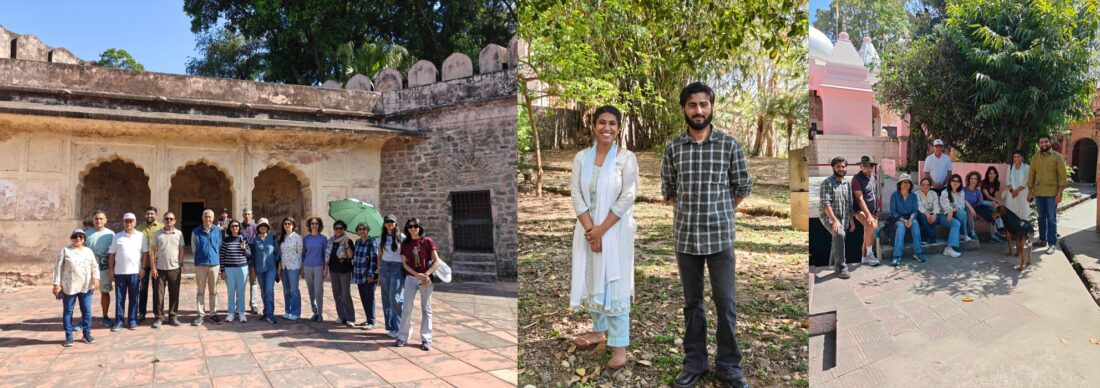
The Walk. On the morning of the walk, a group of fifteen enthusiastic history buffs gathered at the designated meeting point at the parking lot of Pinjore Gardens. I felt the buzz of curiosity in the group, it was like we were back in school on a history tour.
Our Walk Leaders, Harnoordeep and Himani, introduced themselves and gave us a brief overview of the Pinjore Heritage Walk. The approximately three-hour guided walk was designed to cover the Pinjore Mughal Gardens, followed by a visit to the ancient Bhima Devi temple complex, and subsequently, the Top Nath Matha.
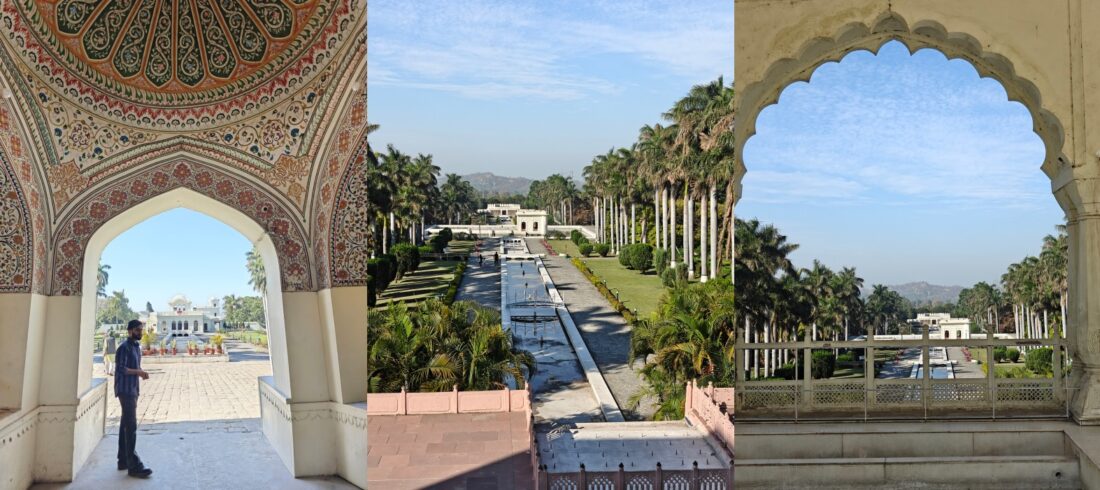
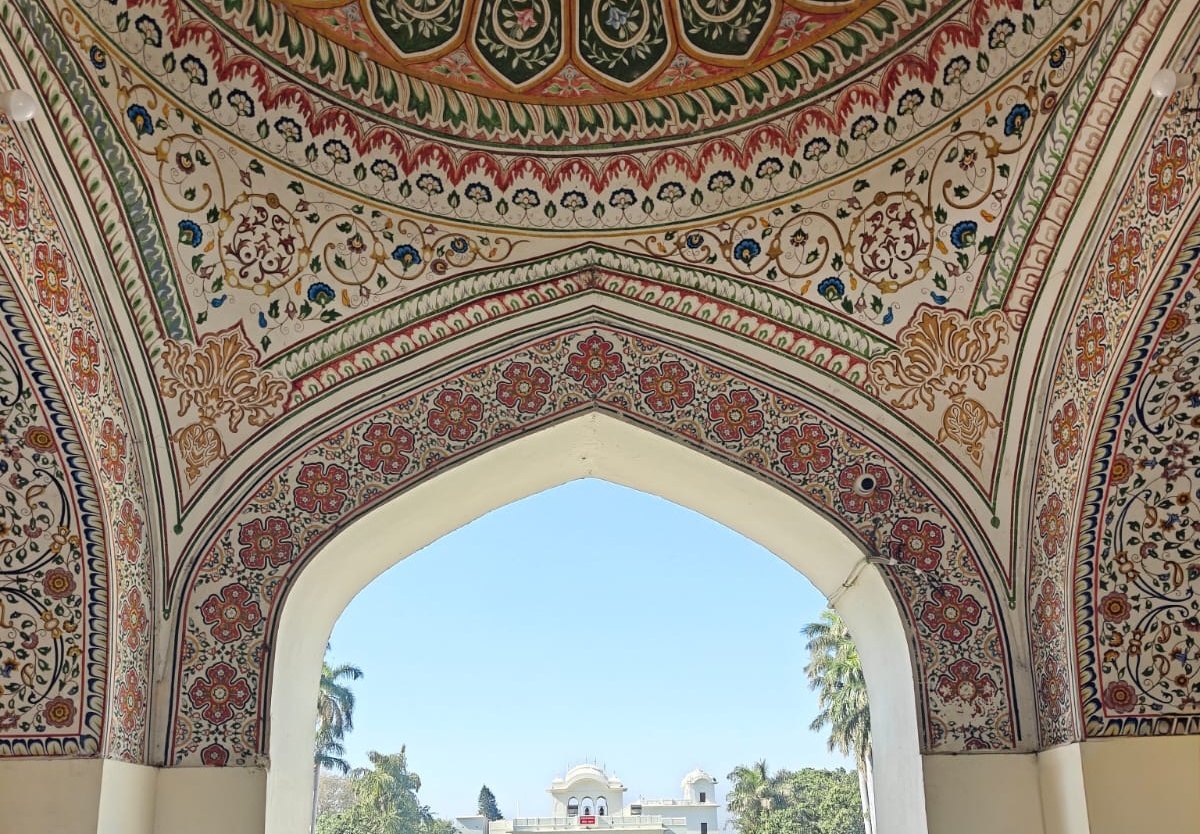
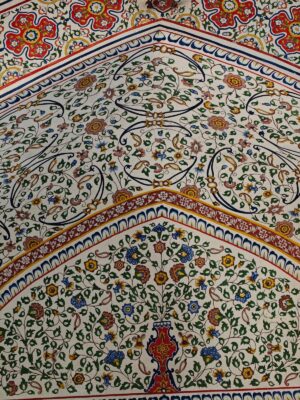
Pinjore Gardens. We entered the grand doorway of the garden and the first thing we saw were the beautifully painted ceiling frescoes. While the paintings have been refurbished by the Haryana Tourism Department, the floral designs are very evidently Mughal in nature. At this point, Harnoordeep narrated the interesting story behind the creation of Pinjore Gardens, also known as the Yadavindra Gardens.
The 17th century, 100-acre Mughal era garden is celebrated for its seven-terraced layout amidst orchards of mangoes, lychees, peaches, etc. It has fascinating waterways and fountains fed by a natural spring, and royal pavilions with balustered columns and cusped arches adorned with floral frescoes and murals.
Built as a summer retreat in the foothills of the Himalayas by the Mughal governor, Fidai Khan Koka, the land was rewarded to him by Emperor Aurangzeb for his contribution in the construction of the Badshahi Mosque in Lahore. According to folklore, the local rajas were not happy with the presence of the Mughals in Pinjore and wanted to find a way to drive them away. But since they were no match for the military might of Aurangzeb’s governor, they chose a clever ploy to ensure his exit from the region.
It is said that when Fidai Khan visited the Pinjore gardens along with his regal procession, it was ensured that the local gardeners, flower women and fruit sellers visiting the Mughal zenana, were all the ones suffering from the goitre disease. Stories were spread that the contaminants present in the air and water of the foothills meant that no resident remained unaffected. Horrified by the stories, the women of the zenana implored Fidai Khan to take them away, lest they lose their beauty and charm. With the evidence of the disease staring in his face, he left the beautiful gardens, eventually leading to its abandonment by the Mughals.
In 1775, the Maharaja of Patiala, Amar Singh, bought the Pinjore gardens from the Sirmur Raja, Jagat Prakash. The abandoned gardens were reduced to growing roses for making attar perfume for the king, before being restored to their former glory by Maharaja Yadavindra Singh. He later gifted it to the government at the time of Independence. It was renamed as Yadavindra Garden in his memory.
After listening to the fascinating story of the garden’s past, we proceeded to walk down the pathway, along the length of the beautiful fountains. Built in a style similar to the Shalimar Bagh in Kashmir, the Pinjore gardens are spread across seven terraces. The main entrance opens into the first terrace, the highest, which has a pavilion built in the Rajasthani–Mughal style. It houses the Rang Mahal , where royalty sat and enjoyed the beauty of the garden and the gushing fountain waters all around.
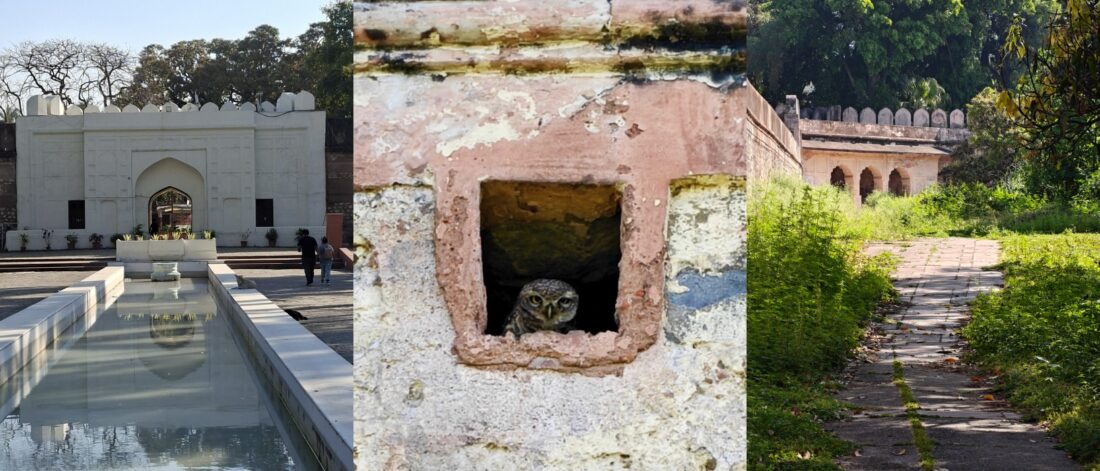
While the maintenance of the fountains and gardens needs much improvement, we could imagine its former glory and splendor. The marble lined fountain pools flow towards a cascading waterfall as one garden terrace leads to the next one. The layout of the fountain pools, the pathways on either sides, the green grass and flower beds on the outer ends are similar to the layout of the Taj Mahal.
The second terrace houses the Sheesh Mahal or the Palace of Mirrors. It’s covered with tiny mirrors on the walls and ceiling to reflect the light emanating from strategically placed lamps. Presently, these pavilions have been turned into guest rooms by the Haryana Tourism Authority, so they were locked, and we could not see them from inside. This felt like a huge travesty, and I was quite appalled at the reduction of a historical marvel to very ordinary guest rooms. But then, such is the state of affairs in many historical sites in India. There is an urgent need for the maintenance of these monuments to be accorded a more substantial budget, and much better upkeep.
The Jal Mahal or Palace on Water is on the fourth terrace. This was known to be the zenana or the women’s quarters. Surrounded by water on all sides with only a side pathway leading up to it, the beauty of this pavilion is on the inside. Since it is open on all sides, there were no locks and we could see its walls and ceiling decorated with beautiful floral frescoes.
Somewhere between the Jal Mahal and Sheesh Mahal, we turned to the left onto a pathway leading into the orchards. We could see the water works constructed over a natural spring. It was the source providing water to all the fountains in the garden, and we couldn’t help but wonder at the ingenuity of the 300 years old hydraulic genius.
We continued on the pathway along the boundary wall of the garden. Harnoordeep asked us to observe the big chunks of stone embedded in the wall bound together by a mixture of lime and mortar. The almost 15 feet wall had clearly stood the test of time. We noticed how many of the stones had chisel marks on them, while many seemed to be broken chunks of old temple remains. The corners where the wall turned had old quarters meant for guards and even horses.
We walked along the old fort walls, talking about history and political affairs while leisurely admiring the greenery that had made a place for itself on the ancient structure. That’s when we noticed a wise old owl quietly staring down at us from its nest high up in a cranny in the wall. Rashmi, a fellow book club member, couldn’t resist reciting an apt sher, ”Barbaad-e-gullistan karne ko bas ek hee ullu kafi tha, har shakh pe ullu baithey hain, anjam-e-gullistan kya hoga.” That sure gave the past a context into the present, and we all laughed in agreement!
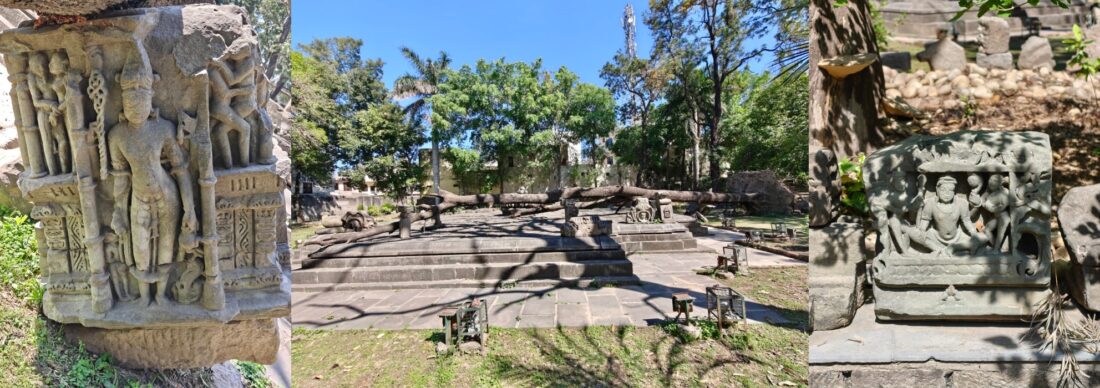
Bhima Devi Temple Site Museum Complex. Barely a five minute walk from the Pinjore gardens, the Bhima Devi Temple is an on-site museum spread across a large compound filled with old trees and museum rooms that house the excavated relics.
The temple complex holds the excavated remains of an ancient Shiva temple, the stone plinth of which is still intact. Numerous broken pieces of the temple pillars, statues, etc. are displayed all around the complex. Himani took us around the area, explaining the pieces to us and the significance of the religious iconography. She told us the story of how the site was accidentally discovered when local authorities were clearing an old tree that had fallen in a storm many years ago. In a strange coincidence, a recent storm had brought down a tree on the very same plinth just before the Pinjore Heritage Walk.
At this point, Himani asked us to take a break and brought out delicious sandwiches and juice for everyone, ensuring that we were refreshed for the rest of the walk. Soaking in the past as it lay all around us, we sat amongst the magnificent old trees, feeling transported into time. It was so tangible, the feeling of being connected to the past.
Topnath Matha
The last leg of the tour was to the Top Nath Matha. Some in the group called it a day and left, while seven of us trudged along with our Walk Leaders towards the Matha, curiosity taking hold of us as we walked the 15 minutes distance to our destination. Along the way I had an interesting discussion with Harnoordeep about the evolving relevance of religion and spirituality in the different decades of our lives.
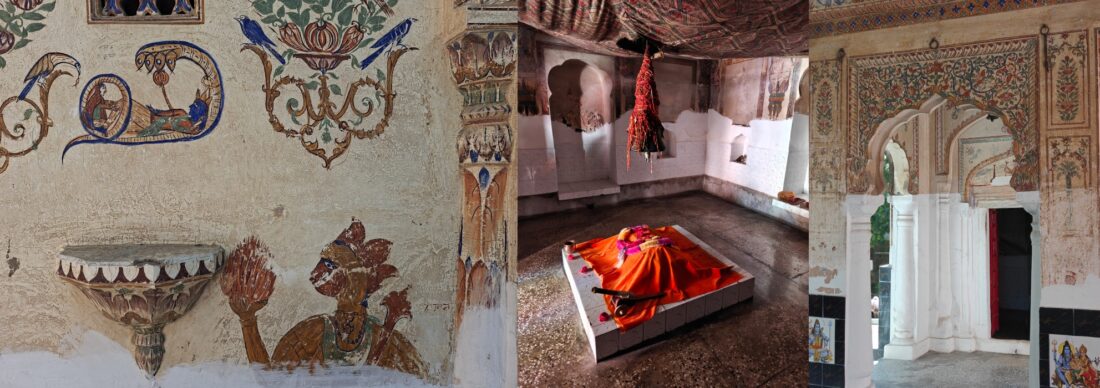
Soon after reaching our destination, we took off our shoes before entering with curiosity and reverence. The complex comprised the main temple; a natural pond; housing for the temple caretakers; and delightful bel and mulberry trees, with ripe mulberries strewn all over the floor.
The Top Nath temple was constructed under the patronage of the Maharaja of Patiala. Its walls are painted with murals that are almost 200 years old. The most noteworthy point is that the deities in the murals are depicted in clothes as per the local customs of the time. For example, Hanumanji’s mural shows him in a cap and a dhoti.
The main shrine of the temple is believed to be the spot where the Swamiji of the matha had taken samadhi, and eventually passed on. We were offered some prashad by the kind Swamiji and his wife as he narrated some interesting stories about the temple. It was amusing to see the ubiquitous dogs wagging their tails at the sight of the prashad being offered.
As we headed back to the Pinjore Gardens parking area, there was much to talk about on the way. The Pinjore Heritage Walk had made us feel a deeper connection to the past – what had started as a walk about the heritage structures, had also become about the lives lived and traditions preserved.
It was inspiring to see how the two young history buffs have successfully combined their love for history and archaeology, with their organisational skills, to conduct these tours that celebrate India’s rich heritage. So, Rashmi decided to find out more about Times of Yore and the force behind it – its founders, Himani and Harnoordeep.
The Pinjore Heritage Walk made the past so relevant and relatable that it reminded me of Santayana’s words, “Those who cannot remember the past are condemned to repeat it.” Considering the turbulent times we are living in, we could do with a lot more of these reminders. So, let’s start at the beginning – what drew you to study Archaeology, and how did Heritage Walks become a part of your journey?
Times of Yore: We were drawn to archaeology through a curiosity about how people lived in the past beyond text. They also lived through objects, spaces, and landscapes. Heritage walks became a natural extension of that, as they allowed us to translate academic knowledge into something experiential and accessible.
We all have studied history in school – is there something textbooks don’t teach but fieldwork and walks do?
Times of Yore: Textbooks rarely capture the sensory and spatial experience of sites. That’s where fieldwork comes in. It teaches you to read landscapes, notice silences, and understand how context shapes meaning. Those are the things you can only grasp by being present.
What are the elements that go into designing a heritage walk? Also, tell us about the biggest challenges you face in conducting these walks.
Times of Yore: Designing a walk involves a lot of research, route planning, time management, and audience mapping. There are many variables that can pose a challenge. The biggest challenge is balancing accuracy with engagement while adapting to unpredictable factors like weather, crowd, or varied participant interest.
We noticed that a considerable amount of myth busting had to be managed – how do you handle misinformation or myths?
Times of Yore: Yes, that’s an important aspect of heritage narratives that has to be managed. So, we acknowledge them first, then gently unpack them using evidence and context. Instead of dismissing beliefs outright, we try to explain how and why such narratives emerged.
It’s interesting to see the combination of storytelling and facts in your walks. What do you focus on more to bring places alive for your audience?
Times of Yore: We use storytelling grounded in facts. While the narrative helps people connect emotionally, they are always anchored in archaeological and historical evidence. Our aim is to enable a shift in perspective. In fact, the one thing we hope people take back with them when they join our walk is the ability to look at everyday spaces and recognise their historical depth and significance.
In the various heritage sites, Times of Yore conducts its walks, is there a monument or site that you think deserves more attention?
Times of Yore: One site we find quite intriguing is the Jamal Khan Tomb in Ropar. Its setting, architecture, and relative obscurity makes it a powerful space to engage with layered histories outside the mainstream narratives. We think sites like this deserve far more attention, as they quietly hold rich stories that often go unnoticed.
Are there any changes that you would like to see in heritage conservation?
Times of Yore: It needs more community involvement and less top-down approaches. It is important for conservation to integrate with local narratives as that will ensure heritage remains relevant to the people living around it.
Finally, if could design a heritage walk anywhere in India without any constraints – where would it be? And also, if you could choose to take a walk with any historical figure of the past – who would it be and why?
Times of Yore: We would love to design a multi-layered walk in Varanasi – tracing continuities from ancient ritual landscapes to present-day practices, and exploring how time exists simultaneously there.
As for the historical figure – Muhammad bin Tughlaq would be one such person. While he is often remembered as a tyrant, his reign was intellectually fascinating. Many of his ideas were ambitious and ahead of their time. It seems as much a matter of circumstance and timing that his policies did not succeed. Walking with him would offer insight into the intentions behind those decisions and how vision and reality often diverge in history.
Photo credit: Rashmi B Nayar

Sangita Panag
Sangita is an Economics Hon. graduate who, after years of dedicating herself to her home and family, is now rediscovering the many interests that define her. From her past ventures in interior design, Montessori teaching and business, to her current love for reading and painting, she has navigated the ‘vagaries of life’ with curiosity and grace.
A true nature lover at heart, she finds joy in photographing birds and blooms, not missing any opportunity to capture nature’s ever present beauty. At home she finds comfort in being surrounded by her beloved canine and feline companions. An avid reader, whether she’s discussing her latest book club read or sharing a laugh over coffee with friends, Sangita thrives on connection and the beauty of the everyday.
Times of Yore
Times of Yore is an initiative committed to fostering cultural awareness through the lens of experiential tourism. We believe in uncovering the threads of shared history by offering curated group tours, immersive heritage walks, and hands-on cultural engagements. Our platform celebrates the diverse heritage that shapes our present and encourages meaningful connections with our roots, and with one another. By transforming historical narratives into lived experiences, we aim to cultivate curiosity and a deeper collective understanding.
Note: For group, school and college tours:
Contact – +91 8699030048/9814925700.
Email – timeofyore@gmail.com
I too was part of the heritage walk. Reading about it brought back its memories, made extremely vivid by the exhaustive account written by Sangita. Kudos to her for absorbing and reproducing the features of the walk in so much detail that it is like a photo album – as you read along, the places come alive and you are transported back in time to the sites we visited. Thank you Sangita.
Thank you Brig Nanda. It was an enjoyable trip thanks to the presence of the book club members.
Sangeeta you are so pretty and I love ur article . Makes me want to do this walk for sure with you if we ever meet .
Thank you Namrata. Will surely let you know about the next trip we plan.
The whole package was such a refreshing break from the sickening forwards that have devastated social media platforms. From such thoughtless drivel preaching instant Nirvana and wellness to a leisurely walk through a slice of history abetted by sandvitches and fruit juice just so was a scrumptious treat. Thank you archeology aficionados, the writer of this delectable pot pourri Ms Sangita Panag and Ms Rashmi, who interviewed the old digs and writer ladies.
Haryani Tourism has messed up big time by substituting crude tourism with historicity but then, we do do cut out nose to spite our faces so often do we not? And ASI? It sits somnolent on its ruins, protected not by a desire to keep the ruins alive by care, rules and regulations, strict application of law but by abysmal neglect…institutional helplessness and deep blue enamel boards ubiquitously known as ASI boards…good luck charms?
Anyway, loved the flow of the narrative, its subtle lady like censure of and about neglect balanced by history…walking back in time…
My recall is true and of the Maharaja of Patiala. It was a winter evening in Patiala. I had just been commissioned in 16th Light Cavalry. Our Mess was in Lila Bhavan, a former Guest House of the Maharaja mentioned by a rather lurid Jarmani Das, a courtier recalling Patialas glory days.
The Maharaja was our guest that night and we were all in Cavalry blues…spurs and all. I was nominated his shadow that night, tailing him and, rather late that night guiding him to the Men’s…* I’ve forgotten young man he told me in clipped English. Tall at 6 foot 4 inches, he was true Royalty…Our Ambassador in Belgium, he wasn’t about Patiala Pegs but about refinement…elan…savoir faire. I felt privileged.
So the gardens well named after a good King of yesterday.
The narration is well uber.
Thank you all.
Raj Mehta
Thank you Gen Raj Mehta. The sandwiches and juice did make the break rather refreshing. I agree that between the Tourism dept and ASI these small gems of history could be much better maintained. The anecdote about the Maharaja of Patiala is surely the highlight here!
I have been a ‘ Chandigarhite’ for quite sometime now….and Pinjore has always been an integral part of the itinerary whenever kids/ guests drop in. Yet now , Pinjore has unfolded in a completely new way. The HERITAGE WALK was a different, new world altogether. A great reminder that history is not confined to museums alone. Walking through history, getting to know the hidden stories behind, it breathing through stones, bylanes and quiet conversations.
Now looking at a very familiar place with completely new eyes. Thanks a ton Sangita for widening the horizon.
Thank you Dolly. It’s the little stories that make historical facts more interesting. The Heritage Walk was surely an enriching experience.