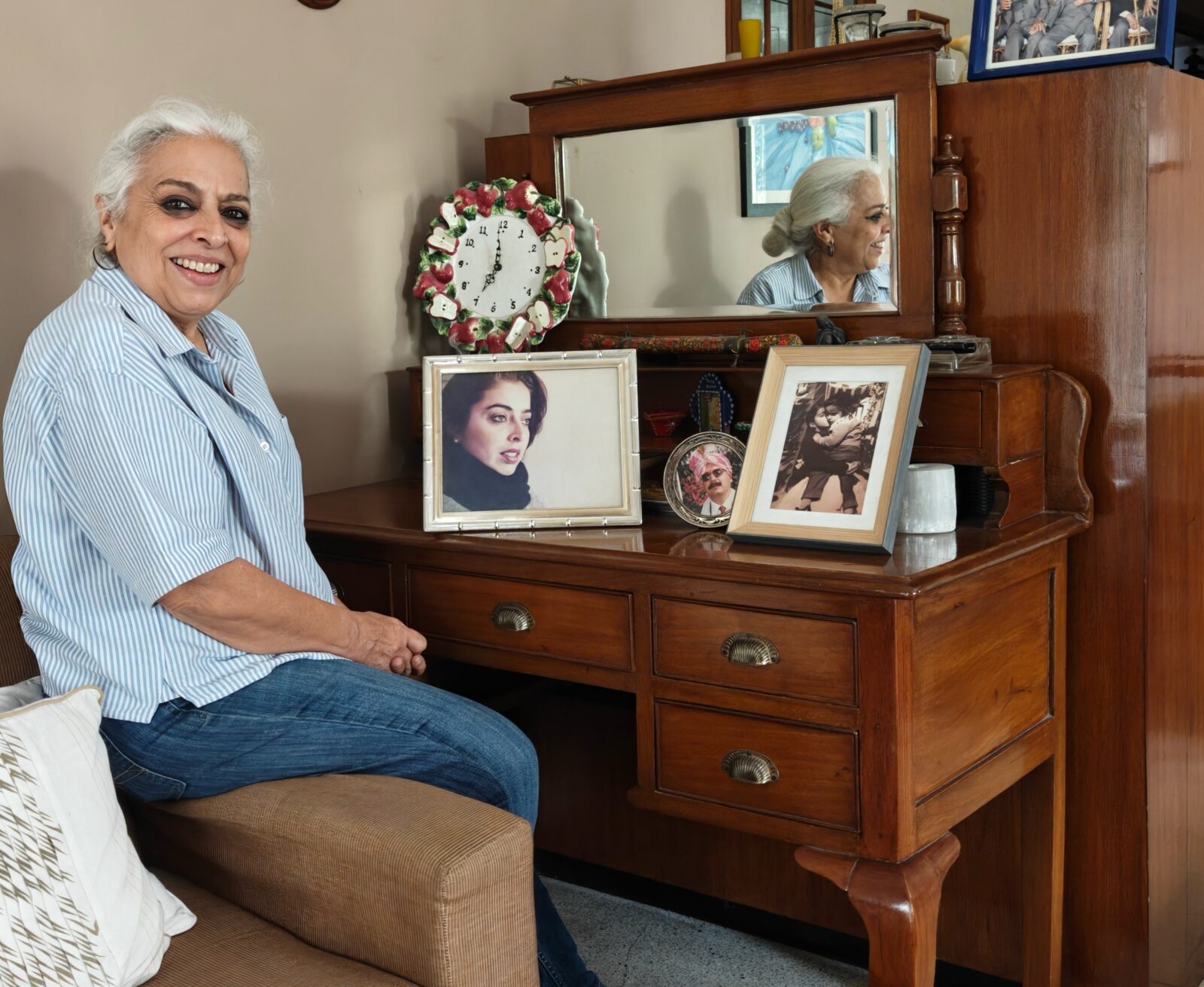
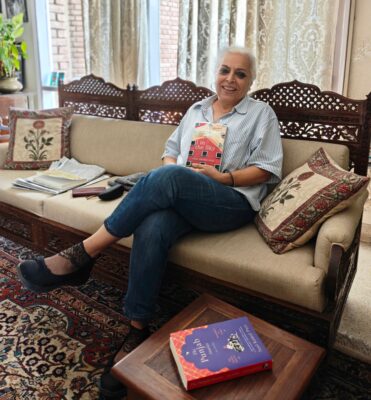
I remember the first time Neel Kamal Puri walked into our English class at college. She would’ve easily been mistaken for a student if the super efficient grapevine of our all girls college hadn’t given us a heads-up on the young new lecturer taking our literature classes. In fact, in anticipation of a young rookie, our batch of seasoned Undergrads were busy laying side bets on how long we’d be able to string her along and keep her from getting any real studying done. Well, all that was about to change, we soon realised.
She walked in very purposefully, calling out a cheery good morning with a big smile that reached her eyes. Neel Kamal Puri looked like she was one of us, and she carried it lightly. So, after a round of easy mutual introductions, when she opened the door to the world of literature and storytelling, unsurprisingly, no one wanted to be left behind.
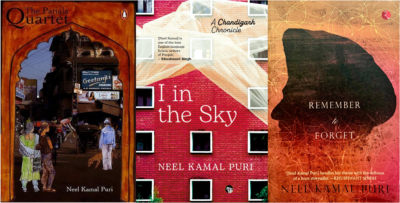
In 2006 when Penguin published Neel Kamal Puri’s debut novel, ‘The Patiala Quartet’, the legendary writer and columnist Khushwant Singh described it as among the best works of English fiction written by a Punjabi. Acknowledged for her compelling storytelling, her narrative comes with a pleasantly unsentimental tone and a deliciously incisive wit.
Neel Kamal’s subsequent novels, ‘Remember to Forget’ and the recently published ‘I in the Sky’ have further cemented her place as a telling voice in contemporary English fiction writing of Punjab. To find out more about the writer and her writings, I sat down with the author over a great cup of coffee and an amazing conversation.
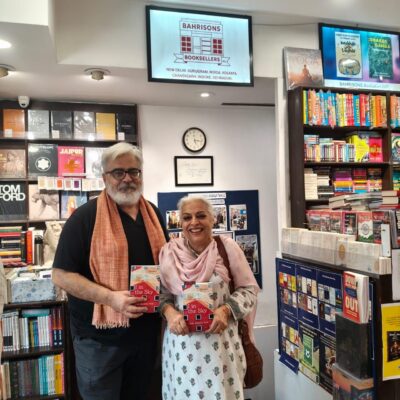
Let’s start at the beginning. When did you first realise you weren’t just someone who loved books, and you had stories of your own that needed to be written?
For a good part of my life I lived with the thought that other people write books and I read them. That the people who write are somewhere out there, in some rarefied world in some other galaxy. Of course, I was always writing – school magazines, college magazines, newspapers, etc. In short, the usual. I also wrote inordinately long letters to my parents from the hostel, which would be passed around page by page for a family reading! I loved words and the weight and thought they carried. But the first time I decided to tell a single, sustained story – I was well into my thirties. The impulse came, not from an epiphany, but from an idle thought. I sat down in front of my computer and thought to myself, ‘let me see if I can write a novel.’ It really was as random as that. And that is how I started writing ‘The Patiala Quartet’.
Your fiction presents Punjab in all its richness and contradictions. Was it important for you to move beyond the familiar stereotypes and tell a more layered story of the region?
Any story of any region has to rise above stereotypes if it is not to become a Hindi film of the seventies. It would be a disservice to the richness of any culture if it were to be reduced to tropes. There are many layers to every human being and every culture. There are no easy blacks and whites. I was born in Punjab and lived here all my life. And if you have lived in a place long enough and loved its largeness of heart and excesses, and laughed at its idiosyncrasies and quirks you are bound to recognise those layers and try to capture them in your writing. For instance, in ‘Remember to Forget’ the syncretic social fabric of Punjab reasserts itself even after catastrophic events like the division of partition and the riots of 1984. And that, to me, is Punjab’s greatest strength.
The women in your novels are neither idealised nor victimised – they simply feel real. What do you think literature still struggles to understand about women’s inner worlds?
Not all women are good and not all men bad. Not all women are perfect. Of course, in a patriarchal world, there are many many more women who are victims. And they have been featured in literature and cinema. But I am happier writing about, or creating women with some agency. In fact, even in situations when they are victims I do like to look for that reserve of resilience which wells up in adversity. For instance, what I am currently writing, yet a novel without a name, features a woman character who chooses rape over death, even though that is seen as a shamefully dishonourable choice. And she goes on to live the rest of her life, not mopingly but reasonably happily.
Inner worlds of both women and men are infinitely varied and there is always something left over for the next piece of writing. So, even if one thinks that everything there is to say in literature has already been said, there is always more. But perhaps women’s sexuality, which is very much a part of their inner world, is a latecomer to the table and has therefore not been written about so much. In fact, most women novelists are also a little squeamish about featuring sex in their novels. In a measure that is what I have tried to do in my latest novel ‘I in the Sky.’
Your novels remind us that history isn’t made only in parliaments or battlefields – it is also shaped in homes, classrooms, and everyday conversations. Do you think fiction often tells the emotional truth of history better than history itself?
There is no dispute between the two. Of course emotion is the domain of fiction and history is predicated on facts. However, they do have a healthy relationship. In the telling of it, the two borrow from each other and in fact, increasingly so, but sometimes dangerously so. Historians know that history is not just a jump from date to date and that there are many stories in between. Novelists know that even fictional events need to be tethered to a timeline. It is when history becomes fiction, and fiction becomes only a dry narration of past events, that we end up with corrupted history and bad literature.
For me, the place where I locate my novels is very important. It is almost a character in the unfolding of events. And therefore, it becomes important to get the history right and to capture the ambient spirit that plays a part in the shaping of events and, in a measure, also people.
A question every writer wrestles with – do you write to preserve memories, to understand them, or to let them go?
For me writing is not the psychiatrist’s couch where I offload memories, where I get rid of them so that I can become whole and mentally healthy. My memories are my mainstay. But of course, I take them apart, using a bit here and a bit there, adding a bit of spice here and toning down something else there. The process perhaps helps me understand life and relationships better. And I would not see it as a way of preserving memories either because those would be better housed in memoirs or archives or recordings. They are the clay that I shape to make my pot. It is just that I enjoy sitting down at my table and writing.
You have spent years as both a teacher and a novelist. Has teaching literature influenced the way you write fiction, or has writing fiction changed the way you looked at literature in the classroom?
I was a teacher much before I became a novelist. Teaching and growing older certainly made me understand literature better. I began to find that as I stood in front of students and spoke to them about a novel or a writer or a historical context or a social setting or the myriad ways of approaching a text or tackled their questions and interventions, I felt the disparate pieces in my own head also falling into place. Teaching is an interesting process because you end up teaching yourself too. I am sure a decade of teaching, before I began writing, must most certainly have shaped the way I write. It was not of course, a conscious process but I suppose I leant to learnt to look at narrative structures, at the mode of entry into a narrative, at the complexity of character, at the underpinning of a context and so many other things. But it also helped that I had been exposed to the world of journalism where I encountered people and places and events that would ordinarily not be a part of my everyday existence. And that fed into the content of my novels.
After three novels, what questions or themes continue to pull you back to the writing desk?
When I look back at my novels, all three of them, I can see migration as a running theme in all of them. That engagement probably comes from the fact that my parents and their families were migrants at the time of independence which, in the Punjabi mind is synonymous with partition. I grew up listening to the stories of my parents and therefore, belongingness or rootedness or the lack of it thereof, perhaps triggered my first novel. I did not belong to Patiala and yet I did, having spent seventeen of my growing up years there. In fact, migration is at the centre of a lot of the contemporary contentious discourse too. And even when I think that I am done with it, I cannot be sure that it will not resurface. It is already rearing its head even as I write my fourth.
I don’t really have a sort of list of questions or themes that may preoccupy me in the future because when you are immersed in the writing of one novel you are holed up with it and not looking very far ahead. And in any case, themes are not singular, even though that is often how a classroom may approach a text. There are always multiple thoughts and threads running through a narrative.
You’ve influenced generations of women. What is the one piece of advice you could give to the women who are still looking for that thing that lights them up – the thing they’re good at, that gives them a sense of purpose and makes them want to begin something new?
Perhaps something as prosaic as ‘It is never too late.’ It is also not so necessary to be embarking on something new to feel a sense of purpose. They could still be doing something that they were always doing and continue to do just that as long as they are happy doing it. Of course, there is a sense of adventure in launching into unchartered terrain. I do have friends, professional women, who decided to learn designer stitching, others who wanted to learn music and still others who wanted to learn dancing. And sometimes, in an unguarded moment, I think it might be fun to be a crooner in a club. The bottom line is really that one enjoys what one decides to do.
Finally, if you could invite any writer for a cup of coffee, who would it be?
I would love to invite Salman Rushdie for a cup of coffee. He has a delicious sense of humour and an imagination that often runs away with him and that might make it just the most scintillating cup of coffee.
Neel Kamal Puri
Born in Ludhiana, studied at YPS Patiala, GCG 11 Chandigarh and Panjab University, Chandigarh. Taught literature and journalism to undergraduate and postgraduate students at the Post Graduate Government College for Girls, 11, Chandigarh for 37 years. Wrote for a number of newspapers, including a weekly column in the Indian Express, Chandigarh. Also reviewed theatre, music and dance events for the same paper.
Publications:
1) ‘The Patiala Quartet’, a novel, published by Penguin in 2006, republished by Rupa in 2012 and Speaking Tiger in 2015.
2) An extract from the above published in a volume brought out by Penguin to commemorate 20 Years of Penguin in India in 2007.
3) A short story ‘Kailla’ included in a volume First Proof – The Penguin Book of New Writing from India – 3, brought out in 2007.
4) ‘Remember to Forget’, a novel, published by Rupa in 2012 and republished by Speaking Tiger in 2015.
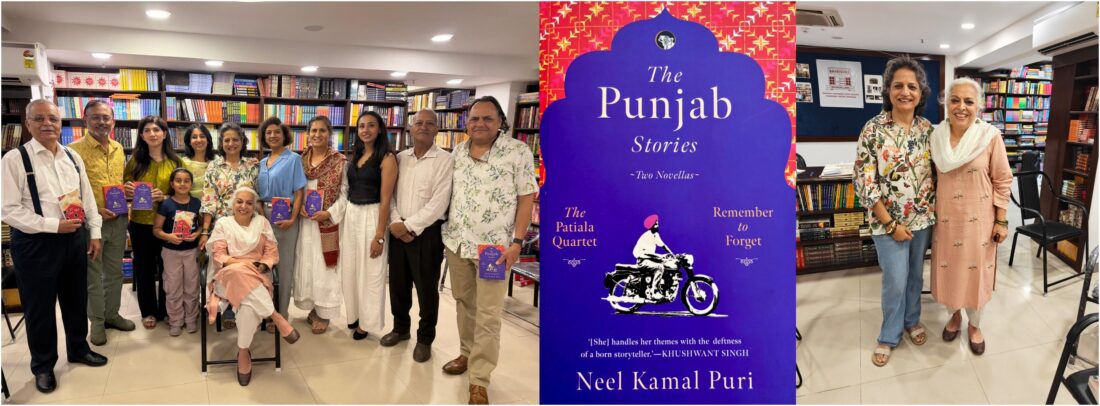
5) An omnibus edition with ‘The Patiala Quartet’ and ‘Remember to Forget’ published by Speaking Tiger in 2024.
6) ‘I in the Sky’, a novel, published by Speaking Tiger in 2026.