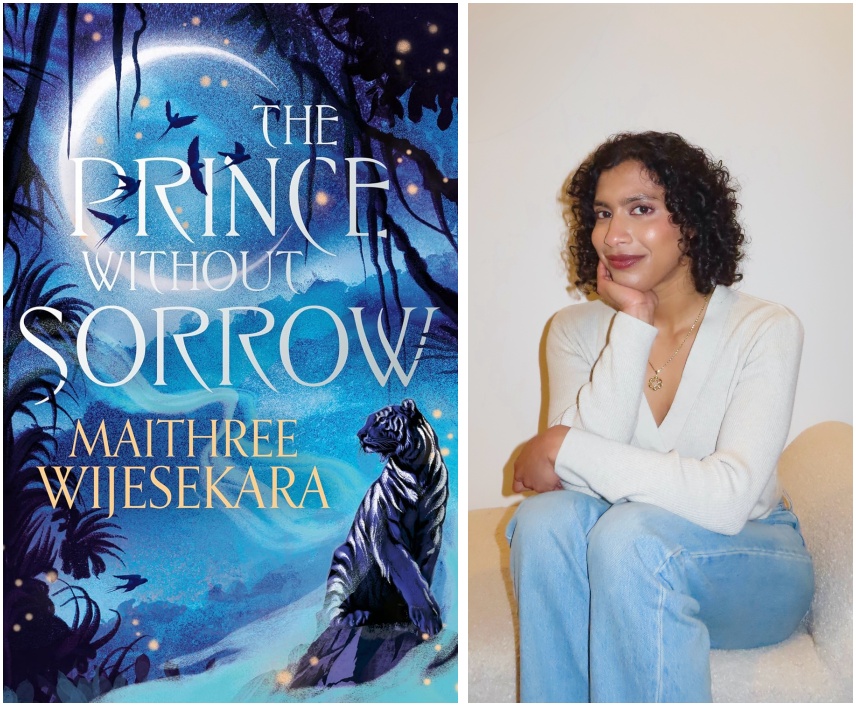
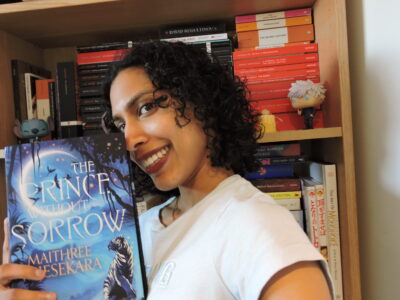
Maithree Wijesekara, a Melbourne-based Australian-Sri Lankan author, soared onto the Sunday Times bestseller list with her debut, The Prince Without Sorrow, in 2025. This year, her much-anticipated sequel, The Witch Without Memory, earned high praise from readers and the British Fantasy Society.
The author’s Obsidian Throne fantasy trilogy, inspired by Emperor Ashoka of the Mauryan Dynasty, skillfully blends myth and fantasy with family drama and adventure. The story draws readers into a vivid world brimming with magic, royalty, witches, and political intrigue.
The trilogy follows Prince Ashoka, a peacemaker and pacifist striving for peace in a world torn apart by his father’s hatred of the mayakari, and Shakti, a courageous and resilient mayakari who endures the brutal loss of her aunt and village at the hands of Emperor Adil, Ashoka’s father. Alongside a vibrant supporting cast, this sweeping dual-POV epic delivers a whirlwind of action and unexpected twists that keep readers glued to the pages.
It’s been a genuine delight to interview Maithree and discuss the mesmerizing fantasy world she has brought to life.
Maithree, what made you choose fantasy as a genre? Was this something you were always drawn to? And how did the idea of this story come to you?
I’ve loved the fantasy genre for as long as I can remember! As a kid, I think the first fantasy books I read were the Deltora Quest series, and my love for the genre just grew from there. Because I read a lot of fantasy, the majority of stories I wrote as a teenager on my dad’s chunky old laptop were fantasies, too. The genre feels most natural to me.
The idea for The Prince Without Sorrow came to me in 2020. I have always held a fascination for Emperor Ashoka. He is a notable figure in Buddhist history, known for his turn from cruelty to nonviolence. This change was what interested me. It brought about a lot of questions. What made him adopt principles of nonviolence? Was the transition difficult? Was he affected by the guilt of conducting such brutal military campaigns?
I can never get answers to these questions because, as a historical figure, there is limited information on Emperor Ashoka. At times, his life is fictionalised, which I suspect is done to lend more gravitas toward his turn to pacifism. Nevertheless, those initial set of questions was how the character of Prince Ashoka wandered into my head. My Ashoka’s story isn’t meant to be taken as historical fact – the existence of magic, witches, and nature spirits tells you as much. What I wanted to do was take the arc of his historical namesake and reverse it. I wanted to explore what it would take for a staunch pacifist to abandon their ideals and turn toward violence.
Can you tell me more about your writing process for your novels and the research that went into these stories?
Along the spectrum of plotting versus pants-ing, I think I’m somewhere in the middle. I like to write down a basic outline, note down major plot points and character arcs that I know I won’t deviate from because they are absolutely necessary. For the less critical parts of the story, I like to give myself a little leeway and let my mind wander. Too much rigidity and I feel too constrained. Too much freedom and I feel as if I’m meandering. I think the process that I have now is a good balance.
Similar to the question above, because there was limited historical information on Emperor Ashoka, I took a lot of creative liberties. There are, however, small nods here and there to the emperor and his life throughout the series that I hope those who are familiar with him will appreciate.
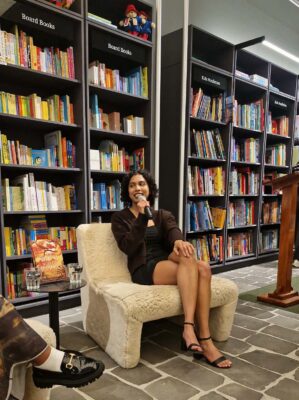
What did you enjoy most about building your fantasy world?
I absolutely loved creating the nature spirits! It was such fun to incorporate bits and pieces of the natural world into these wraithlike creatures who appear in animal form. My favourite spirit I’ve created thus far (barring book three) is the elephant that appears in The Witch Without Memory, with its broken tusk, yellow-grey hide, and crown of leaves.
Even though Ashoka, Shakti, Rahil, and Aarya live in a fantasy world, they come across as very real, and complex characters with strengths and flaws. What do you hope readers will take away from these characters?
Transformation is a pretty big theme in the first book. Both Ashoka and Shakti undergo change (for better or worse). While Shakti is more receptive to change, Ashoka is more hesitant. What I’d want readers to take away from these characters is that we as humans aren’t static, and that we’re always in flux. Who you are today is not the person you are tomorrow.
Your stories dive straight into powerful themes: authoritarian rulers, nature’s destruction, LGBTQ+ love, and the fear of those labelled as ‘dangerous others.’ Did you set out to explore these ideas, or did they emerge as your story unfolded?
I did set out to explore these themes – they were all part of the initial outline. The destruction of the natural world in particular, was something I really wanted to include. I was partly inspired by the Studio Ghibli film, Princess Mononoke. The movie is a bloody and meditative exploration of the relationship between humans and the natural world, which is personified in the form of wild gods. I think most Ghibli fans can directly spot the inspiration!
You’ve spoken about “infusing” aspects of Buddhist philosophy in your stories. Could you elaborate more about this?
Of course! I was raised in a Buddhist household, so I grew up learning about karma, rebirth, attachment, the samsaric cycle, etc. They’re interesting concepts, so I wanted to embed them into this particular story, and this was mainly done through the mayakari (witch) code.
The mayakari code is loosely based on Buddhist principles of nonviolence. Do no harm to others, do no harm to yourself. This is extra crucial for the mayakari because they have powers to curse the living and raise the dead. I also thought it would be interesting to have a group of women with such dangerous abilities, but actively choose to avoid using them!
I also had qualms of my own that I wanted to address. Namely, nonviolence and how it can rub up against revolution or resistance. The mayakari are persecuted. They are arguably more powerful than the Empire and yet refuse to wield their powers to defend themselves because of their principles.
As honourable as nonviolence is, they are up against an enemy that simply does not care if their morals are just or not. And, in such cases, one has to consider if, perhaps, clinging so staunchly to a code is worth it if your people’s survival is at risk. I explore this through Shakti, who questions and often rejects the mayakari code of nonviolence.
Maithree, you are a dentist by profession. How do you balance this with your writing career?
So, I’m currently working in a non-clinical capacity, because I’ve decided to do a postgraduate course on top of the writing (apparently, I like to make my life extra difficult). Before that, though, I was working part-time as a dentist.
For me personally, I knew that I wouldn’t be able to juggle full-time dental work and writing. Dentistry can be a stressful job, and on the days I came back home from work, I found that I was wiped out and had no creative energy to write. Because of that, I made the decision to work part-time, which worked really well for me.
For people who can make full-time jobs and writing work – hats off to you.
What advice would you give someone starting their first fantasy novel? Is there something you wish you had known when you began writing?
Write, write, write! Get that idea down on paper! Outline! Oftentimes, we spend so much time just thinking endlessly about an idea, and how yes, one day I’ll put pen to paper/fingers to keyboard, but never do. It can seem daunting to begin writing any novel, but if you never start, then you will never finish.
What kinds of stories do you enjoy reading, and which authors have left a lasting impression on you?
I love reading fantasy, literary fiction, and classic novels (Dostoyevsky’s Crime and Punishment is one I’ll always remember). These days, however, I’ve been on a non-fiction kick. I’ve recently read – and highly recommend – The Language of Trees by Katie Holten. It’s a collection of essays, poems, and other extracts on trees, our relationship with them, and their influence on the natural world. Given our current climate, it’s a sad but hopeful text.
The Witch Without Memory, your second novel, left readers at a cliffhanger. Is there anything you can share about the third and final book in the trilogy?
Nothing much, except that the ending is justified 🙂
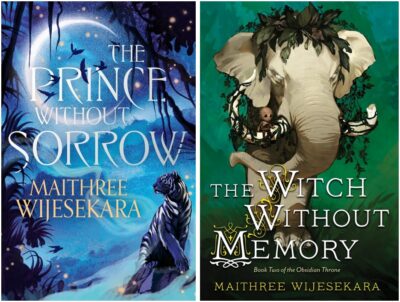
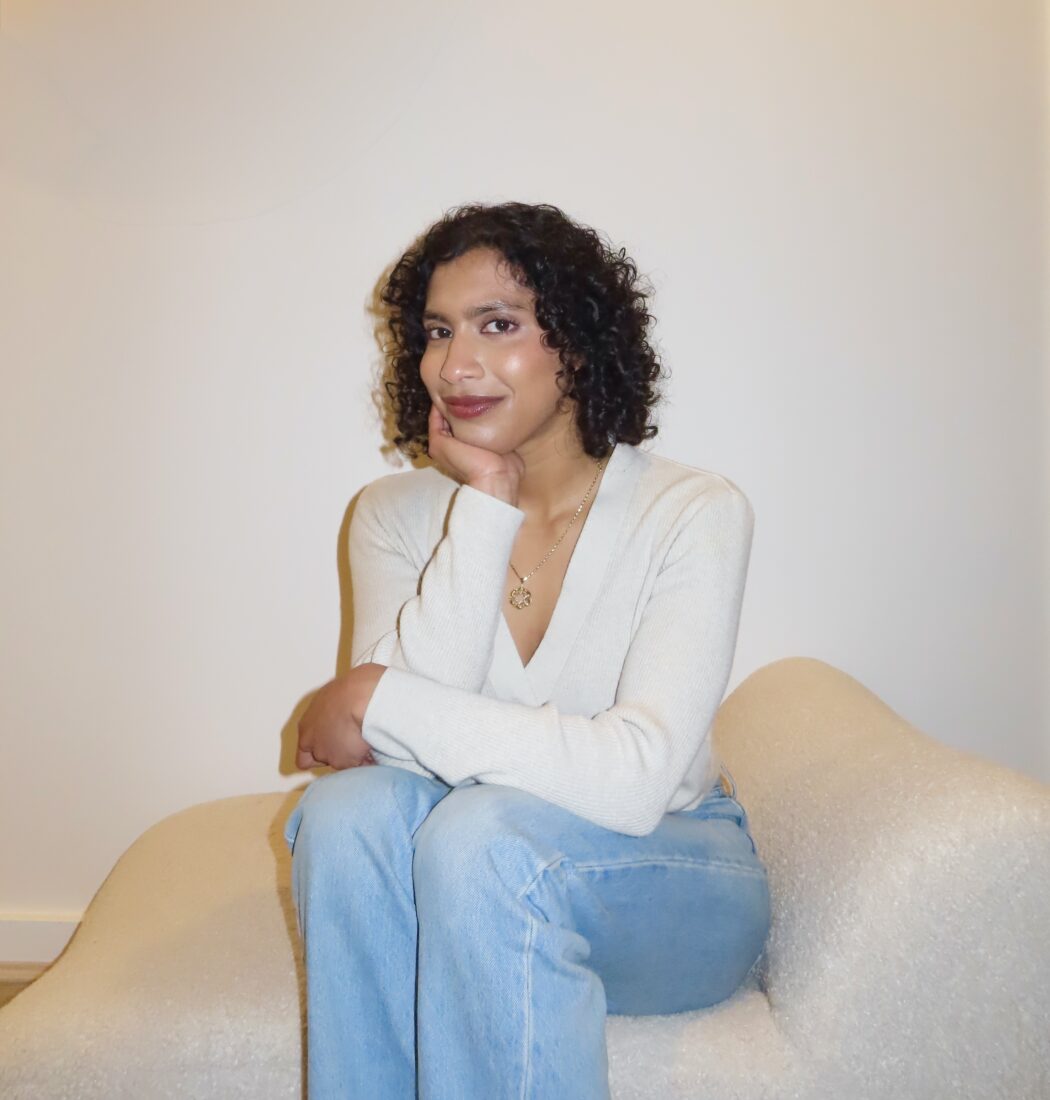
Maithree Wijesekara
Maithree Wijesekara is an Australian-Sri Lankan author based in Melbourne. Graduating with a Masters in Dentistry in 2021, she splits her time between telling people to please brush their teeth, and writing stories inspired by the fantastical and the real world. When she isn’t writing, you can find her attempting to finish her never-ending TBR pile and ingesting unhealthy amounts of coffee. If given the chance, she will slip in a mention of her dearly departed Labrador during conversation.