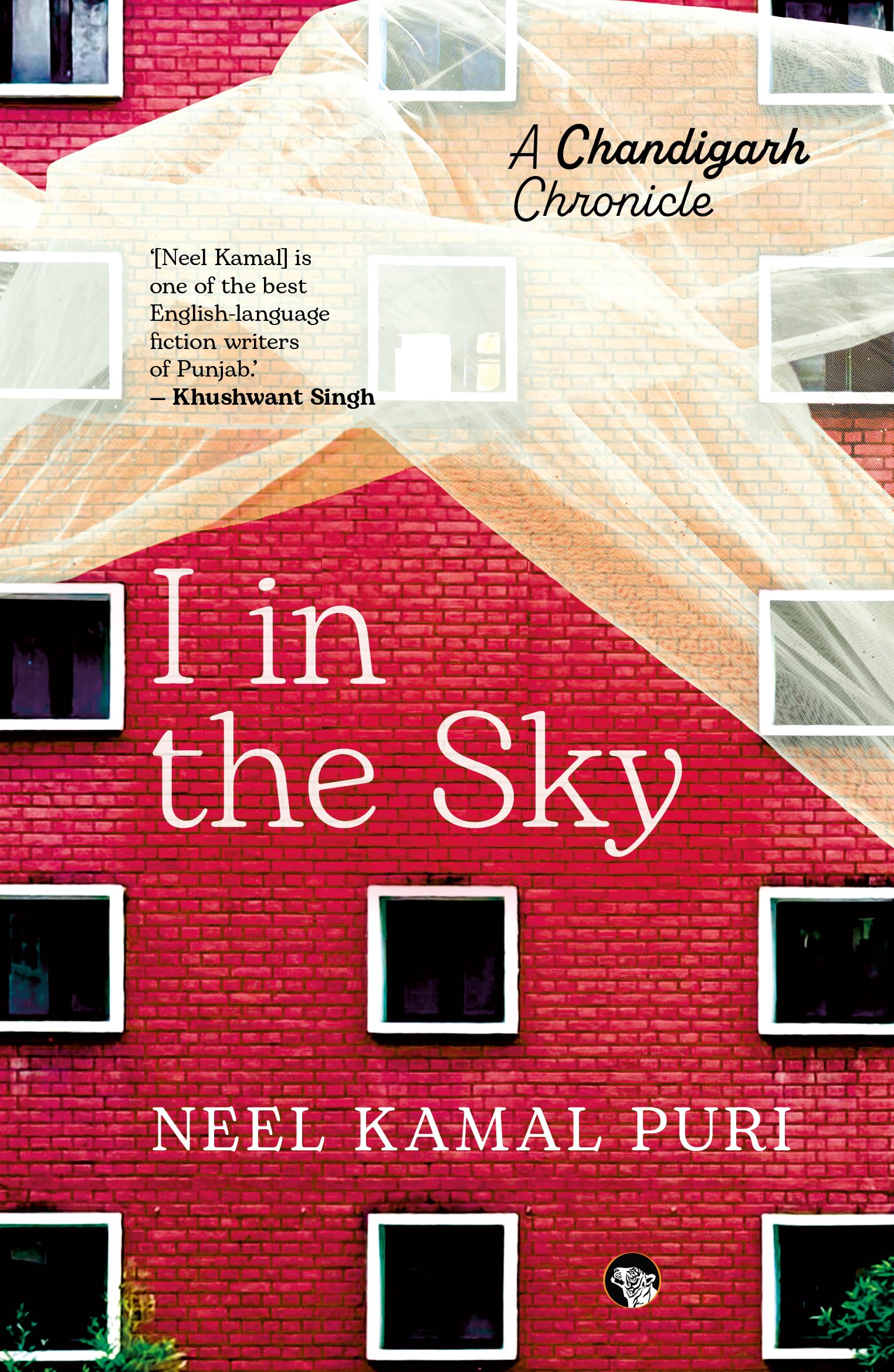
Praised by Khushwant Singh as “one of the best English-language writers of Punjab”, Neel Kamal Puri made her mark withThe Patiala Quartet and Remember to Forget. Her latest novel, I in the Sky, further consolidates her literary standing in contemporary Indian writing.
Subtitled, “A Chandigarh Chronicle”, the novel weaves together the story of Bubbly, her parents Billo and Randy, and the city of Chandigarh, which came into being in 1948. A city that was “meant to be a projection into the future” was later “accused of being a repudiation of the past” as it had nothing to show in terms of history and culture. How fickle human nature can be! The very city that was once feted for being modern, functional and beautiful, was faulted for not having roots in antiquity. “The undulating landscape with wheat fields stretching right up to the foothills of the distant Himalayas”, had offered a clean slate – from the perspective of those who planned, developed, and populated it – when it was forged into a city by wiping out twenty-two villages.
The novel opens with Bubbly’s suspected suicide: “The body had floated to the surface in Sukhna Lake, face upwards, staring at the sky, trying to see if it might rain.” The dead Bubbly then becomes “an eye in the sky. An eye that is only a voyeur…a bird’s-eye view, which can also be an opinion sometimes.” Bubbly’s death is not the end of her. Swaddled in cloud and memory, she reincarnates into a celestial witness – observing from her perch not only the events of her time but also a future six millennia away when the city lies buried beneath the ravages of time. However, excavations uncover the presence of a once-thriving, well-structured city that had worn the crown.
Like Chandigarh, Bubbly’s birth was planned, not accidental. Both were almost like twins. “We shared a childhood and youth. We both had three caregivers and three claimants to our affections. We both battled with modernity in our youth. We both tried to be avant-garde, and we both fell a little short”, Bubbly observes. Their growth trajectories, however, diverge as they age.
Bubbly imagines a future nearly 3000 years hence when Chandigarh remains much sought after, though she had felt a sense of rejection quite early on in life. Looking into the distant future, she foresees the city stripped off its glory, reduced to an abandoned, ghost town as its underground water dries up. Without getting into the specifics and details, the writer visualises a bleak future not only for Chandigarh but for many other cities across the world if no immediate, scientifically driven measures are adopted to mitigate the impact of the environmental crisis. The novel subtly points to many pressing issues that the city beautiful, the country, and the world are contending with. She neither elaborates, nor offers any solution but leaves the readers to reflect on the issues besetting our societies – intolerance, mutual distrust, blind faith and disharmony, among them .
After an initial reluctance on the part of the people to make it a home, Chandigarh gradually evolved into an enviable destination, but the farmers whose lands were acquired for this purpose could never reconcile to what they had lost. They felt dispossessed. The compensation they got was too meagre to be of any value. Except for a few who had the vision and perspective to use the opportunity sagaciously, the compensation most farmers received evaporated in no time. The wide roads of the city, modelled on modern European cities, left the farmers aghast. It symbolised “an indulgence of plenty, an extravagance in the extreme”. They felt betrayed and their sense of outrage simmered as a “subterranean sentiment”. The wide roads were “an affront to their own diminished realities”, an unforgivable “waste of cultivable land”.
Interspersed with Bubbly’s ruminations and reflections, ranging from interpersonal relations and social commentary to the birth of the city beautiful, the author philosophises about “the question of being human”. Speaking in the same vein, she muses that “cities are often human but may not be humane. And relationships are, in any case, a curious mix of contraries”. Humans and cities have many things in common – like humans they have something to show, something to hide. The city beautiful had to live up to its name, it had a reputation to protect. “It had to look a certain way, ready for the ramp, pushing the ungainly under the carpet, edging the slums out of the periphery.”
I in the Sky stands out on many fronts – linguistic felicity being the most conspicuous of all. Replete with beautiful phrases and expressions, the novel sparkles. It has the potential to be in the big league for its finesse. This is how Neel Kamal Puri weaves together the beauty of the landscape and the initial reluctance of people to settle here: “The poetry of the place, which featured hills in the background and balmy breezes softly caressing the foothills, was quite obscured by the sheer presumptuousness of creating a city out of thin air.”
The novel is populated with many characters. However, quite a few of them look sketchy, hardly delineated in depth and detail. They fail to leave a lingering impression. There are places where the novel falls into a digressive mode and goes almost into a ramble. Such passages bulk up the story but do neither add value to it nor to its structural coherence. But a work that excels in so many other ways, these are minor hiccups.
To sum up, I in the Sky compels attention. The broad framework of the novel seems to have been inspired from Salman Rushdie’s Midnight’s Children. Neel Kamal Puri had been an academic before she turned to fiction, and her choice of words, allusions, and imagery have an unmistakable stamp of her literary background. Her previous works drew attention and received critical acclaim, but I in the Sky has cemented her legacy as a powerful literary voice.

Praveen Kumar
Praveen Kumar, who taught English language and literature in Himachal Pradesh for close to 30 years, retired as Principal from Govt. College, Sarahan, Dist. Sirmaur. He was a member of the Board of Studies in English for undergraduate classes for a two-year term. He co-edited an anthology The Threshold in 2002, which was prescribed as a textbook for B.A. 1 st year students of H.P. University. In 2022, he co-edited an anthology of short stories entitled Let Us Tell a Story. He occasionally writes poetry, both in Hindi and English, short pieces on literature and topics of general interest, and also runs a podcast named The Joy of Ideas. Presently, he is the
coordinator of English Teachers’ Forum, Himachal Pradesh.
Thank you for your insightful review. And, as you say, the novel asks many questions. If I had all the answers I might have been a spiritual guru instead of a novelist!😄 However, hopefully some answers are there.
The digressive narrative voice came to me quite organically and I have to guiltily admit that I enjoyed the liberty it gave me to pursue some stories and leave some others half done, since they were peripheral to the main story.
Thank you so much for reading and responding to the review. I fully agree with your statement that digressions open many new avenues that may remain unexplored if we stick to a linear narrative. Regarding the questions raised in the novel, I’d say that certain questions are too big to be addressed in a fictional format. They require brainstorming by experts from diverse disciplines. So, I really appreciate that you touched on them and gave the readers something to ponder over.