I saw Paprika written right on top of my shopping list for Budapest. What have I come to, I thought, rolling my eyes as we reached the iconic Central Market Hall to buy it by the bushels. The smiling saleslady didn’t seem the least bit surprised as she guided us adeptly through the different varieties. It took a quick surreptitious look around to realise I wasn’t the only Indian there. I wondered if we’d lost the taste for our own fiery chillies, but then again, if it wasn’t for the smoked paprika – the Hungarian goulash would be just another stew!
As far as I was concerned, our Europe itinerary began and ended with Dubrovnik and Prague. So, when my husband suggested adding Budapest to an already packed itinerary, I was reluctant at first, but in the spirit of carpe diem – I agreed.
Budapest was a blur of 24 hours, but smart planning and a liberal dose of serendipity (like the paprika in the goulash) turned it into a very special sampling. Hilly Buda and flat Pest, conjoined names with distinct entities, came together as one entity as late as the 18th century. The city that houses almost one third of Hungary, was at one time the co-capital of the Austro-Hungarian empire along with Vienna. The Turks ruled here too, and their legacy’s evident in the famous ‘hammams’ or baths that channelise the natural springs spouting healing waters.
Time is of the Essence
Given the absolute paucity of time, unfortunately walking was the first to take a leap out of the window. Budapest, like all European cities, has a plethora of good walking tours, but none that matched our time there. So, we took the 24 hour pass, which gave us seamless access to the underground metro and overground trams and buses. Also, we decided to divide our time. The afternoon we arrived was spent in the Buda side, and the following morning, we explored the Pest Castle Quarter.
Szia Budapest
We reached Budapest at noon, prepared to take the expensive cab ride from the railway station to our stay, but no one was willing to take us. So, we went back into the station and to the metro underneath it. A tram ride and a short walk brought us to our accommodation in District V, where we quickly settled into the spacious apartment before heading out.
Minarets and Markets
The bustling streets of District V were marked by a plethora of restaurants and grocers catering for the familiar, closer-to-home palate. At a crowded square, we found thronging groups going inside a distinctly Moorish brick building. It was the Dohany Street Synagogue, the biggest in Europe. We admired its onion domed minarets and exposed brick finish that were so unlike anything around. Made in the last century, it had served the huge local Jew population and marked the edge of the Jewish ghetto during the second world war. Now, it was like a place of pilgrimage, housing a functional synagogue, a museum, and a holocaust memorial.
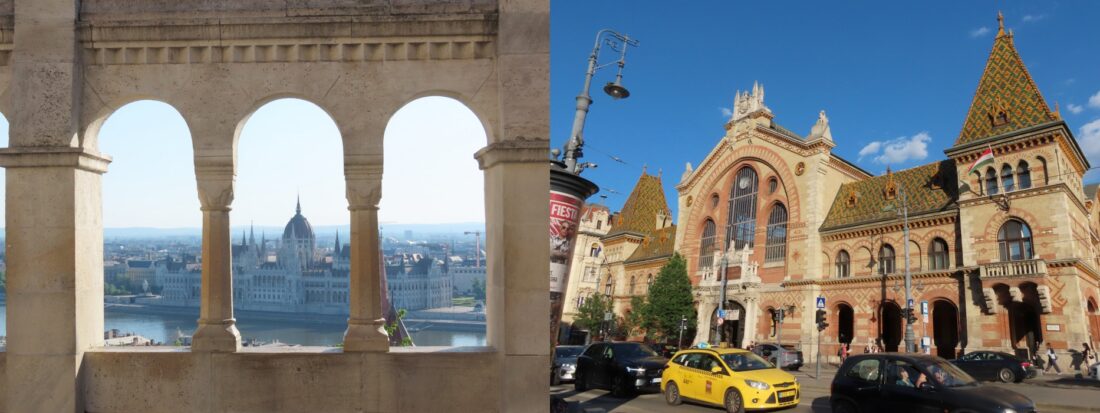
Next, we made a beeline for the Central Market or Great Market Hall. The largest and oldest marketplace in the city – the brick, iron and glass structure topped with colourful green and yellow Zsolnay tiles, looked warm in the evening light. In the vaulted interiors, we found groceries (paprika), fresh produce, souvenirs, local handicrafts et. al. Unfortunately, there was no time to linger and sample the street food available as closing time was soon upon us.
By the Danube
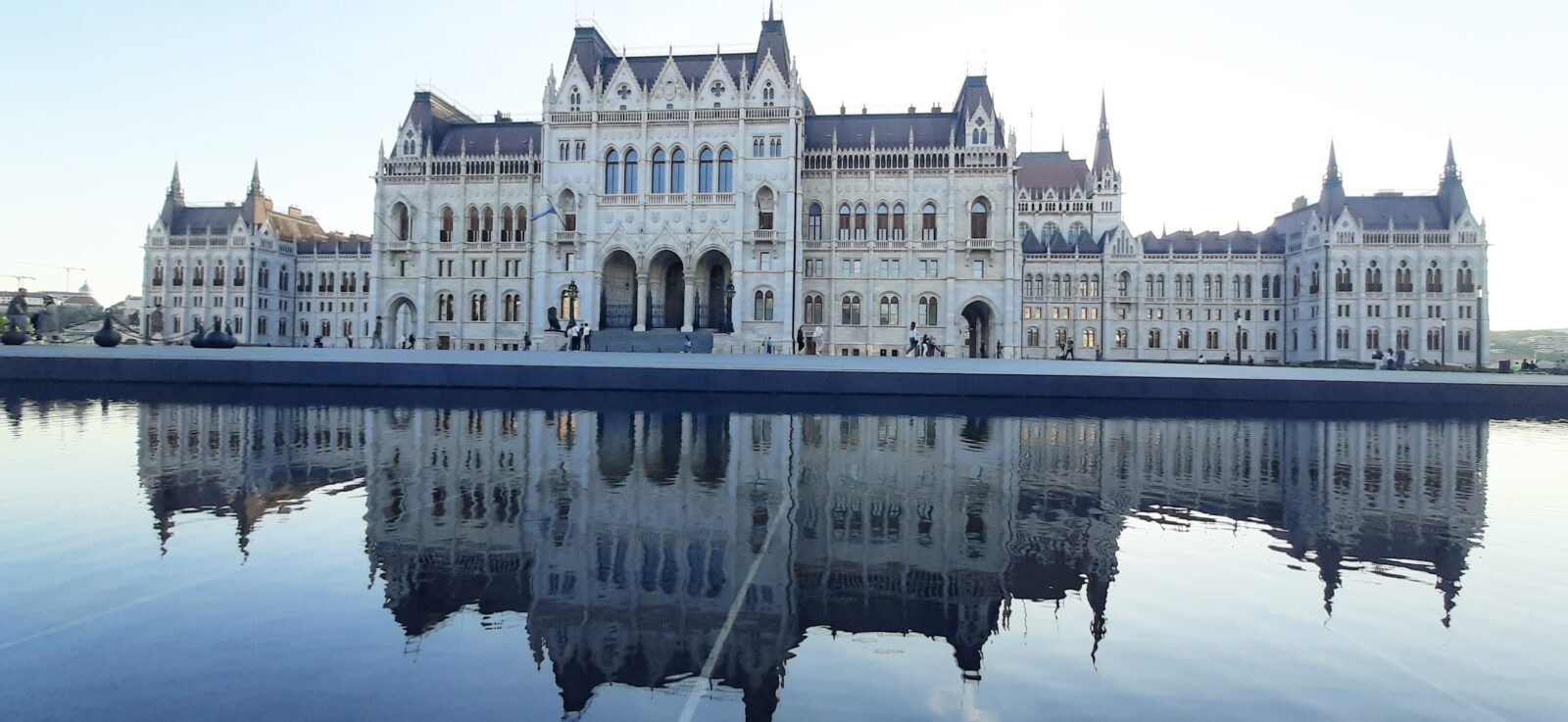
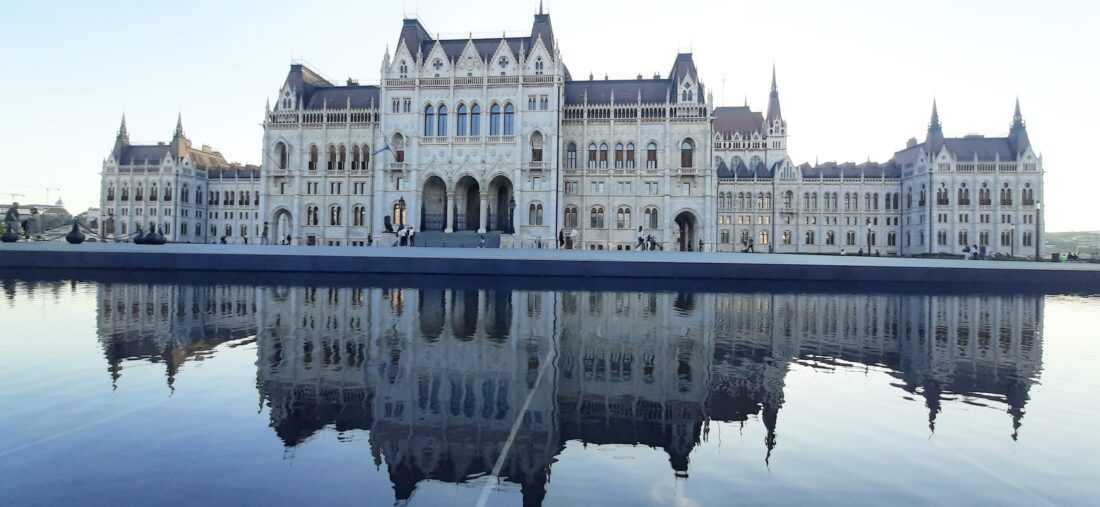
We caught a very retro looking tram number two from a nearby intersection. It clanged along the riverfront and made for spectacular sightseeing. The Danube, barely blue here, had all the important monuments facing it. We got off at the humungous neo-gothic parliament building. Its entrance guarded by two regal lions with coiffed manes and noses in the air was reminiscent of an Italian renaissance church, with perfectly symmetrical wings spreading on either side of a central cupola.
Though we could not take a tour of the interiors or waltz down the waters of the river to see it all lit up in the night, we soaked in the beauty from afar. A lot of renovation work was in progress around the expansive square, but it was artfully camouflaged behind the screens draped on the building, with the purported final design printed on it. That ensured we saw the eventual façade long before it materialised.
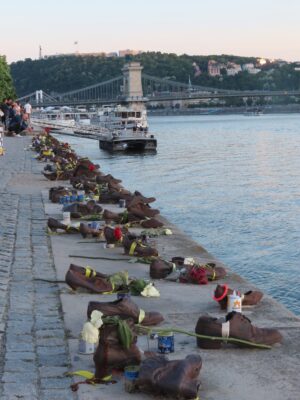
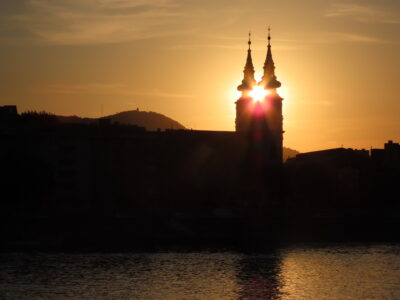
From there, we strolled to the promenade by the river towards the holocaust memorial, Shoes on the Danube Bank. The brilliance of the poignant memorial lay in its simplicity. The cast iron shoes of men, women and children point at the river that swallowed the Jews who were shot there after being made to take off their shoes. A moving reminder of the horrors meted out during the war, we stood there for a few moments as the sun set in a fiery orb between the spires of a church across the river.
Tea or Tipple and Trdelnik
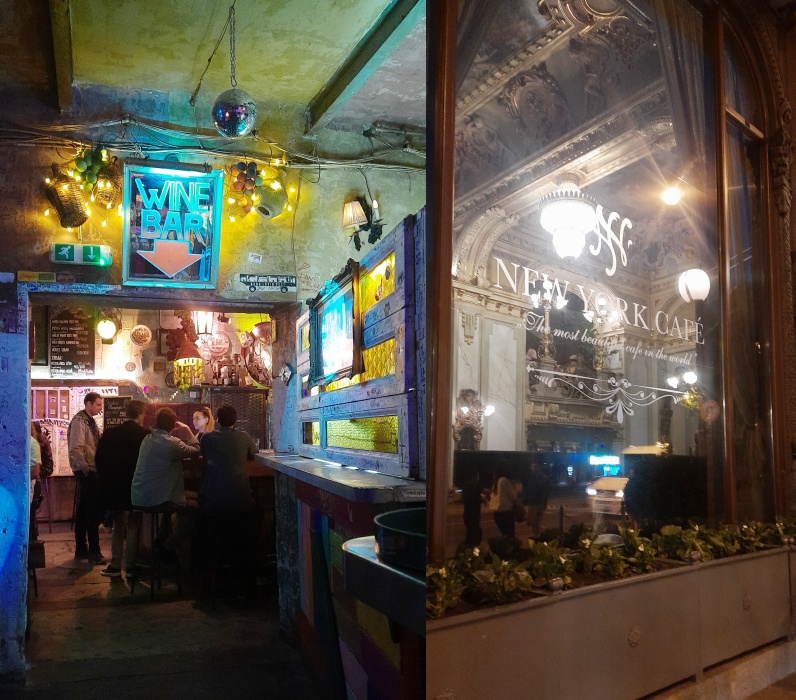
Retracing our rides, we crossed the iconic New York Café, rated as the most beautiful café in the world. With its opulent interiors brightly lit, it beckoned cozily, but as expected, there was a long waiting. So, we headed out to sample the night life of Budapest and discover the bar that had set the bar trend in the city.
The crowd was building up outside the ruins of Szimpla Kert, the original Ruin Bar. The music was pulsating, the setting was eclectic and drinks flowed. People thronged through the maze of rooms of the dilapidated industrial building that was now living its second life as a rocking party hub.
The evening ended on a sweet note with the traditional trdelnik, freshly done. The layered pastry dusted with sugar and cinnamon, then wrapped around a wooden roller and turned a toasty brown over fire, was everything it was said to be. And quite rightfully, it was demolished as soon as it arrived, warmly served.
Castle, Churches and Count Dracula
Early next morning we caught a bus to the base of the historic hill that housed the Buda Castle quarter. The castle ensemble (seat of power) reduced to a near rubble, had been rebuilt and redesigned innumerable times since the 10th century. It had survived the Mongol hordes, the Turks, World Wars and the rise and ebb of numerous dynasties. The streets were near deserted as we climbed along with just a handful of people and arrived at the Fisherman’s bastion. Its walls with arches made the perfect frame for a view of the deep Danube making a natural moat below, and of the sprawl of Pest beyond the Parliament.
Apart from the famous Chain Bridge, the two banks of the river are bound together by many bridges. We saw Chinese couples with their personal paps, make the most of the fairytale turrets and arches in the morning light. The massive neo-gothic Matthias church towers dwarfed everything around, its colourfully tiled roof adding an eclectic element to the pristine white exterior. The slender bell tower soared above even the church.
From the Holy Trinity Square, we walked through a lane lined with quaint buildings, one of which had a labyrinth underneath where Count Dracula was once held. We crossed the Sandor Palace, home to the President, and went on to the Buda Castle, which houses the national library and the historical museum. It was not opening time, so we made do with the impressive statue of the Duke of Savoy for company.
The clock was ticking on our time in Budapest and it was difficult to rush with the blooms beckoning a lingering look, and a last picture. It was a whirlwind trip to a city that had risen resiliently time and time again. Someday, perhaps, we would walk through it at length, but for now, a glimpse from the outside had to suffice.
Fact File:
Getting Around – The Budapest Basic Travel Card (BKK) offers unlimited rides on buses, trams and the metro for different durations. They are available at all transport hubs.
Stay – In the Buda side, stay near the Castle area or District I and in Pest in District V or VII. Another option is staying close to the Deak Ferenc ter, a hub where a lot of the metro lines and trams intersect.
Mandvi Mankotia-Rawat
Mandvi Mankotia Rawat wears many hats. She believes firmly in horizontal growth, strictly metaphorically speaking. A law graduate, a language trainer, an educationist, a travel writer and a yoga instructor. She is a passionate traveller and avid photographer. Besides having her own travel blog, her travel articles have been published in local newspapers, Natgeotravellerindia and Outlook Traveller online. Her stories are as much about her escapades and experiences as about the places she explores.
A wonderful article, very interesting !!!
Inspite of a short stay the author has covered the places extremely well.
Thank you so much! Yes, we managed to use the trams to enjoy a lot of Budapest’s sights😊
Totally Immersive & Inspiring!
Mandvi you truly bring the city to life for readers miles away. This is a beautifully articulated complete guide that perfectly balances rich history, modern vibes, and great recommendations. Your passion for travel is contagious nspiring others to pack their bags. It genuinely makes me want to hop on a tram and start exploring immediately. Budapest beckons—keep writing!
Thank you so much!! Coming from another great traveller it means a lot😊 We all need inspiration to take the tram lesser taken sometimes.
Mandavi… yet another beautiful blog ❤️The way you write doesn’t just describe a place… it makes one feel it, see it and quietly walk through it with you. Budapest truly came alive through your words.
What touched me the most was your description of the Holocaust memorial at the Danube… its silence, simplicity and the emotion behind it stayed with me long after I finished reading.
Your imagery and visualisation are simply amazing… waiting for the next journey already
Thank you so much!! So glad you enjoyed the article. The memorial shows that sometimes less can create a bigger impact.