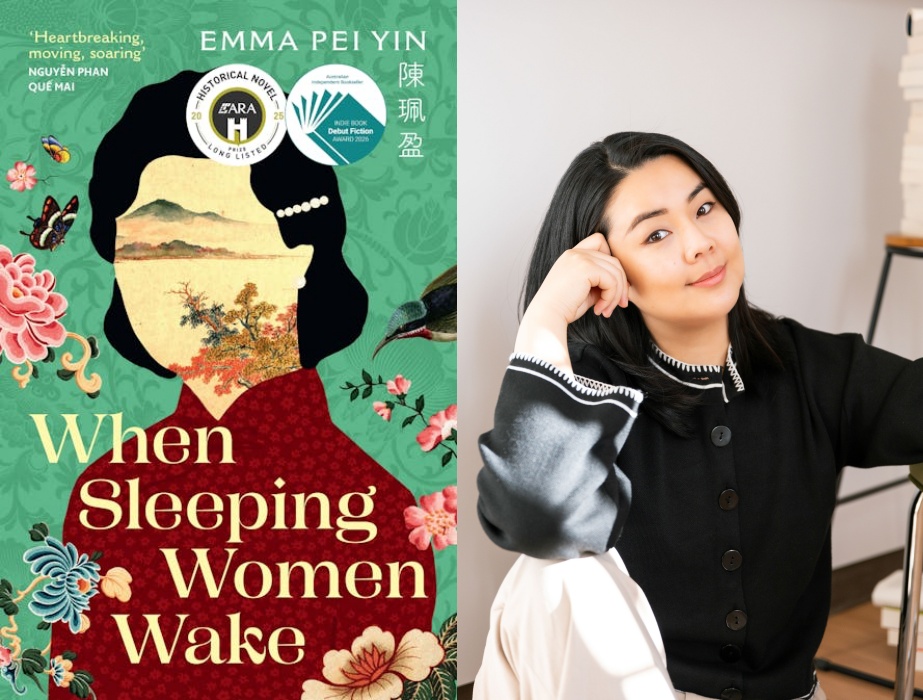
Author Emma Pei Yin’s debut novel, When Sleeping Women Wake, is a story of survival, endurance, and courage. Set against the backdrop of the Japanese occupation of Hong Kong during World War II, the novel revolves around three women: Mingzhu, the first wife of a wealthy Chinese man, Qiang, her strong-willed and courageous daughter, and Biyu, their loyal and beloved maid. This debut earned a spot on the ARA Historical Novel Prize longlist (2025) and claimed the Australian Indie Book Awards for Debut Fiction (2026).
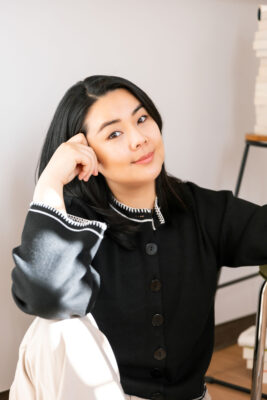
I had the opportunity to meet Emma at the Hong Kong International Literary Festival in March, 2026, and she has been an absolute delight to get to know. Within minutes of meeting her, her intelligence, wit and warmth shone through, matched by a crackling sense of humour. The British-born Hong Kong writer, author and editor is also the founder of yinfluence, an agency that supports PoC, queer, and neurodivergent writers. She champions literacy as an Author Advocate for Room to Read and an Ambassador for Chapters for Change. It is a privilege to introduce her work to our audience.
Emma, many congratulations on your recent award. What does this new accolade mean for a book that has already gained immense traction amongst readers in many countries?
Hey Shikha! Thank you so much. It still feels so surreal to be honest. We know how a book often begins in a private place that is often filled with doubt, mess, and years of intensive labour and love, so to see it travel into readers’ hands across different countries has been deeply moving.
The award is such a beautiful affirmation, I think not just for me, but for the women at the heart of the novel and also to all the women who helped shape it to publication. When Sleeping Women Wake is about voices that have often been overlooked, so every bit of recognition feels like a win!
You speak about a “slow-burning fire, fed by lots of different things over the years”, that led you to write this story. What were these “things”, and what ideas fuelled this “slow-burning fire”?
I’m a sucker for a slow burn, so I suppose it’s no surprise that it took me over a decade to finish this book. Sometimes writers speak about an initial spark, but for me, it was more of an accumulation of things.
Of course, it began with my grandfather’s stories about the Japanese occupation of Hong Kong, but over the years, it became much more than that. It was also the absence I felt as a young reader, not seeing many Asian women centred in sweeping historical fiction, especially women who were complicated, flawed, funny, angry and powerful in their own ways.
It was all the times my grandmother looked as though she wanted to add her voice to my grandfather’s retellings of history, but never quite did. Over time, all of those silences, questions and longings gathered to form the book as it is now.
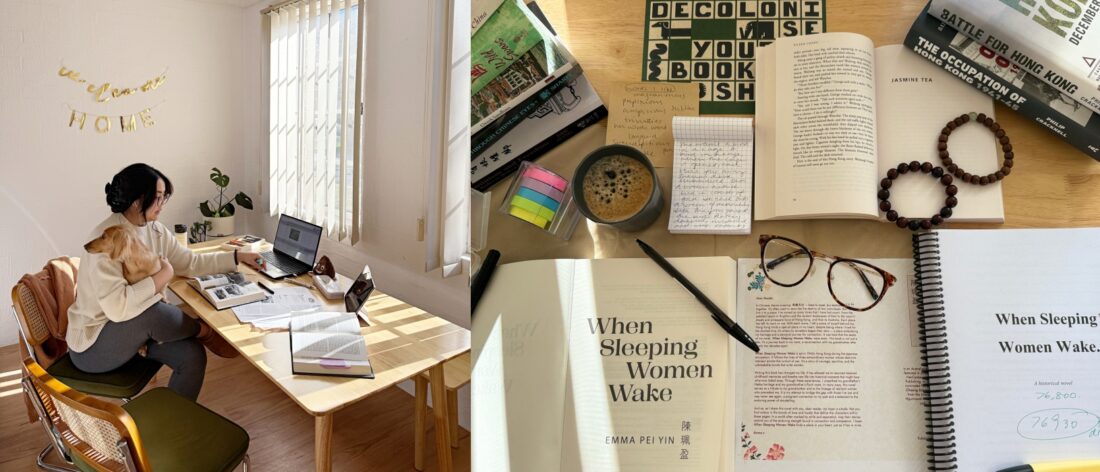
R – Emma’s desk view
Your novel took ten years to complete. How did you cope with the timeline, and what lesson is there in your experience for other debut writers?
Ten years is a long time to live with a story, but I think the book needed those years, as much as I did, because I needed to grow as a writer and as a person before I could write it with the care that it deserved. I looked over an old draft a couple of months ago and saw just how much agency some of the female characters were lacking compared to the newer drafts.
I like to think that has a little something to do with me letting go of an abusive and toxic relationship in my real life and that eventually is what set me free to give a stronger voice to my characters too. The biggest lesson I took from that time was that slowness is not failure. Sometimes, the work is happening even when I don’t punch out a thousand words in a day.
I’m awful at giving advice. All I can say is: be patient and be kind to yourself.
You shared a recent reader review that (absurdly) found your female characters too strong. Can you talk to us about the theme of women’s empowerment in your novel? What do you want readers to take away from each of your main characters, Mingzhu, Qiang, and Biyu?
Ha! You know, if that review had been written by a man, I probably would have rolled my eyes and continued on with my day. But it wasn’t, and I do find it disheartening when some women don’t support other women. Shouldn’t that be one of the most natural things in the world? To see a woman standing beside us and think, instinctively: I’ve got you.
That said, I did find the review hilarious, mostly because I cannot imagine looking at women surviving war, patriarchy, displacement and grief and thinking, ‘Could they perhaps be a little less strong?’ But I also think it reveals something about how women are still expected to suffer prettily.
In the novel, empowerment is not always triumphant or clean. Mingzhu’s strength is in endurance and strategy. Qiang’s is in refusal, in wanting more than the life prescribed for her. Biyu’s strength lies in her unwavering loyalty, her labour, and the quiet moral courage of continuing to love and protect others in a world that gives her very little protection in return.
You can dislike many things about my book, of course. You can dislike the structure, the pacing, the setting. You can even dislike the way I describe the food. It’s all subjective. But disliking a woman simply because she is strong? That’s ridiculous.
What does being a feminist mean to you? I would love to know what fuels your feminist fire, and whether there are any role models who’ve impacted your life.
Feminism, to me, is about agency and the right to be fully human. Fully myself. Fully equal. It is not about women being strong in a palatable, inspirational way, but about allowing women to be angry, ambitious, tender, selfish, brilliant, frightened and contradictory without constantly being measured against a patriarchal idea of what a woman should be.
My feminist fire is, unfortunately, fuelled by the lack of choices some of the women in my family had. Seeing what they could not attain because of the roles they had been prescribed and roped to made me question what I wanted for myself, and what I was willing to accept.
My mother is a prime example. Our bond is a broken one, one I know deep in my heart may never mend, and I often think about how she raised me. I am grateful for what she gave up. But I also saw how, in that giving up, resentment grew. And in that resentment, something painful carved its way into her heart. I am a constant reminder of what she could not attain for herself.
I don’t want to be like my mother. That is not said without sadness. But it is the truth. And perhaps that is what fuels me most: the desire to live as freely, fully and happily as I can, not only for myself, but for the women before me who were never given the chance.
Emma, in a world that doesn’t tire of war, talk to us about the importance of a historical fiction novel such as yours and historical fiction as a genre. What impact do you see or would like to see historical fiction having on readers and the literary world today?
Historical fiction is such a beautiful genre. The past is never truly the past, is it? We inherit its consequences, its silences, its trauma and wounds. Don’t even get me started on generational trauma! That’s a whole other interview!
You know, in a world that is still shaped by war, occupation and displacement, historical fiction can remind us that history is not made only by leaders, armies and treaties. It’s also made in the smaller places and the interior lives of everyday normal people.
I hope the genre encourages readers to question whose version of history they have inherited and to question whose stories have been left out. I think historical fiction, at its best, builds empathy without simplifying suffering. We should read it and sit within its complexity.
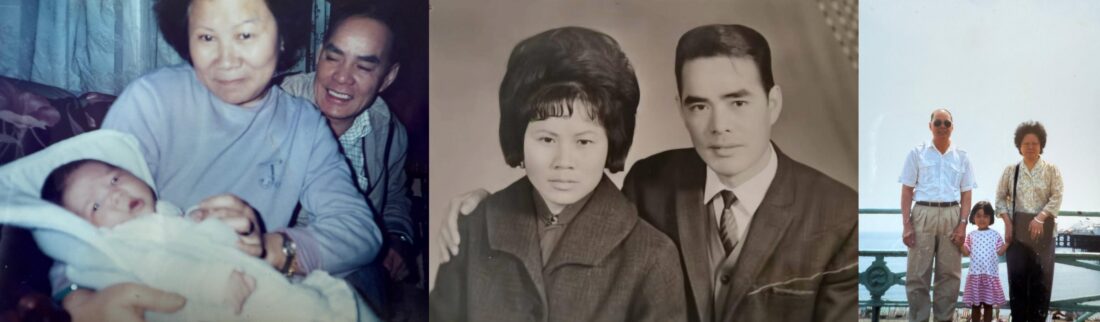
C – Emma’s grandparents
R – Emma with her grandparents in the UK
I would be amiss if I didn’t ask about your relationship with Hong Kong, the city your novel is based in, and your ancestral city as well. From some of your interviews, I’ve sensed that the relationship is slightly complicated. I would love your thoughts on this.
It’s a complicated relationship: bittersweet, but also deeply tender. I moved to Hong Kong when I was thirteen and left when I was nineteen. Those six years were short but takes up most of my memory. I often say that I always fated to be tethered to Hong Kong, but never quite destined to remain there. There’s always that sense of distance, of loving a place partly through memory and partly through return.
For a long time, I think I carried Hong Kong as something internal rather than geographical. It lived in family stories, food, language, rituals, and in the way my grandparents spoke about the past. It lived in the parts of myself I didn’t always know how to explain once I had moved away and each time I went back, I felt both familiar and foreign. I recognise streets, smells, sounds and rhythms, but I’m also aware that the city has changed. And hey, so have I.
Writing When Sleeping Women Wake became one way of closing that distance, I suppose. During all the years I didn’t return physically, I returned through research, memory and my imagination. I conjured images of my ancestors, of the villages, mountains, coastlines…all of it. I think in that sense, the novel became my homesick letter to Hong Kong.
In your experience as a bookseller, are there any changes you’ve noticed amongst buyers since the explosion of book bloggers and bookish social media accounts?
Great question. We are all so much more visibly connected to each other now than we ever have been. Honestly, the digital world is so saturated that it’s overwhelming. I do love how a book recommendation can travel very quickly from a bookseller/ influencer into real-world sales.
As a former bookseller, I find that fascinating, because word of mouth has always mattered, but now it has a much larger and faster stage through social media. I also think readers are more confident asking for specific tropes, representation and emotional experiences and comparisons and that can be wonderful. Even having role models like Dua Lipa be so emotionally invested in literature and reading is containing to pave the way for the next generation of readers to find one another and to connect.
The only thing I find a little unsettling is when people will take a bad review and immediately respond with: I won’t read it then. Because, to me, reading is so subjective. I don’t listen to anyone’s take on a book until I’ve read it myself and have harnessed my own thoughts and views on it.
We would love to know what you’re working on next.
I’m working on another historical fiction novel. This time moving between China, Hong Kong and Liverpool during WWII. It follows siblings who flee Nanking after the Japanese invasion and eventually find themselves caught up in the Chinese seamen community in wartime Britain. I have been researching merchant ships, convoy routes, boarding houses…the lot!
The idea for this novel came to me when I was researching Chinese seamen in the 60s and 70s in the UK—something my grandfather was a part of—and came across the pay discrepancies between the coloured seamen and their white counterparts. Falling into another rabbit hole, I found how the Home Office in the UK declassified documents not long ago detailing how they had illegally deported Chinese seamen after WWII.
The whole thing is horrific and I can’t wait to share this slice of history with people.
Finally, how do you take your coffee?
Extra strong, extra hot with a dusting of cocoa.
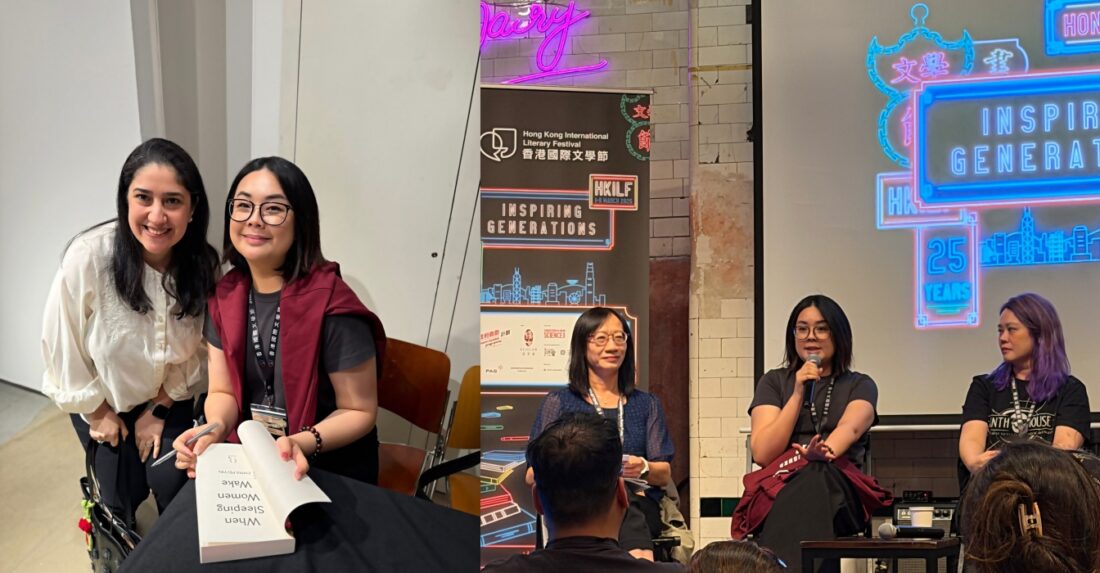
R – Emma Pei Yin at The Hong Kong Literary Festival event – How Stories get Signed, Shaped and Sold
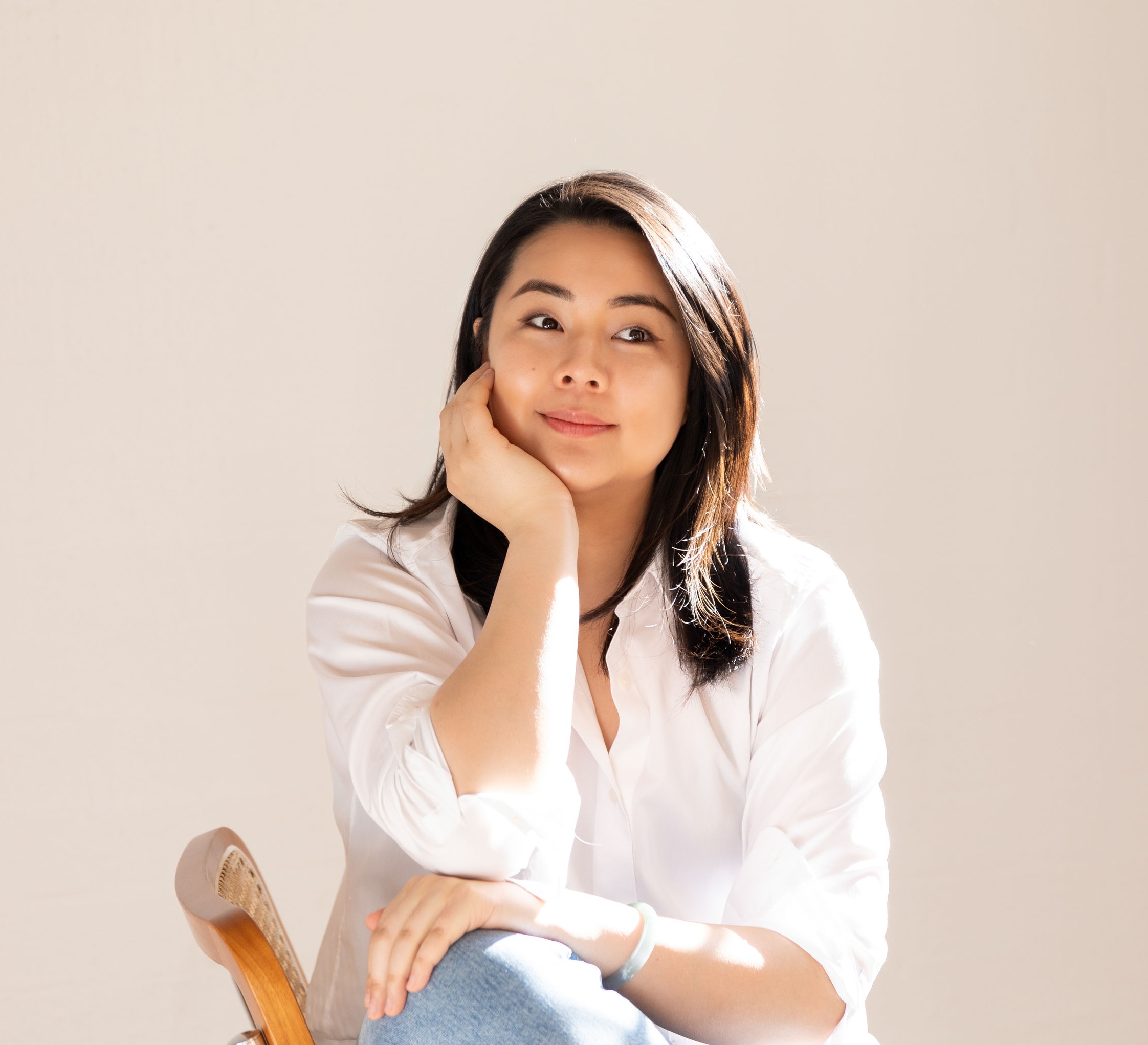
Emma Pei Yin
Emma Pei Yin is an award-winning writer, editor and literary advocate. Her debut novel, When Sleeping Women Wake, has been published internationally and translated into multiple languages.
Emma is the founder of yinfluence, an agency supporting PoC, queer and neurodivergent writers by connecting them with editors and mentors who understand the stakes of telling stories from the margins.
She is an Author Advocate for Room to Read and an Ambassador for Chapters for Change. Emma also co-hosts Served With Rice Poddy, a trans-Tasman literary and cultural podcast and visual series recorded across Australia and Aotearoa New Zealand that centres conversations about books, publishing, identity and community through food-infused discussion.
She is currently working on her second novel with her extremely barky dachshund, Lady, by her side.
Thank you for this excellent, thoughtful interview. Fascinating to learn about Emma Pei Yin’s “When Sleeping Women Wake” and look forward to reading it.
Thank you so much for reading, Holly 🙂 And for leaving your thoughts here.
Thank you Shikha for spotlighting Emma, who is such an inspiring and talented and ferocious young woman and writer. May you both continue to write the truths that have long lay hidden, both in the past and in the present.
Thank you so much, dear Maureen for reading and these kind words. I wish the same for you and your writing 🙂
Firstly, what an eloquent way to describe feminism!
This interview covered a lot of ground in quite a lot of precision. I really enjoyed hearing Emma through these questions. Thank you!
Thank you so much for reading, Erin. Glad you enjoyed the conversation.
Hi Shikha,
I simply loved her thoughts on ‘historical fiction’, so true that we inherit the consequences of the past…Thank you for sharing Emma’s strength and inspiration so beautifully through this interview.
Thank you so much for reading, Simdi 🙂