Most of India today is made up of unimaginative, uninspired basic structures that pass off for “architecture”. Which is an irony in itself considering that our subcontinent has been the cradle for some of the most magnificent structures in the past that were not only beautiful but pushed the very idea of architecture and construction. They used space to create a spiritual experience at the subconscious level.
Architecture is an art form that uses elements of space, decoration, and natural elements to create rasa bhaava as described in Natyashastra. The best example of this that comes to mind is the Ellora Cave temple complex.
Ellora is a cave temple complex that evolved over 6th to 10th century. Besides the monolith architectural marvel – the Kailash temple – Ellora consists of fascinating Jain and Buddhist cave temples and meditation halls that have been cut out from the existing rock formations present in the area. Commissioned by various kings from the Rashtrukuta and Yadava dynasties, these caves are a testimony to harmonious coexistence of multiple beliefs in India.
The morning I along with two more fellow artists made our way to the temple complex, the first rays of the Sun were just touching the tip of the kalash of Kailash temple. The morning champas lay on the path filling the early morning air with promise and a sense of peace. Devotees in their crisp white dhoti prostrated themselves in front of the temple while praying to the rising Sun. Young fitness enthusiasts in their jogging attire were taking advantage of the well laid out paths in the massive temple-cave complex. And I thought to myself that the place I have practically revered since my student days as an epitome of art, imagination and as a symbol of human audacity is a living site!
As we walked down the quiet winding path towards the Jain caves, the lush green forest with gentle meandering brooks and small waterfalls made for a walk that stays in your memory for a long time. The guards we stopped to ask for directions were friendly and helpful. And as we approached cave 33, also known as Jagannatha Sabha, the guard volunteered to show us around.
One of the largest Jain caves in Ellora, Jagannatha Sabha was made in the 9th century. It houses ancient Tirthankara stories depicted in fresco and sculptural form. I being an artist, and another one of us belongings to the Jain community made all the difference in connecting with the breathtaking ancient frescos in the cave.
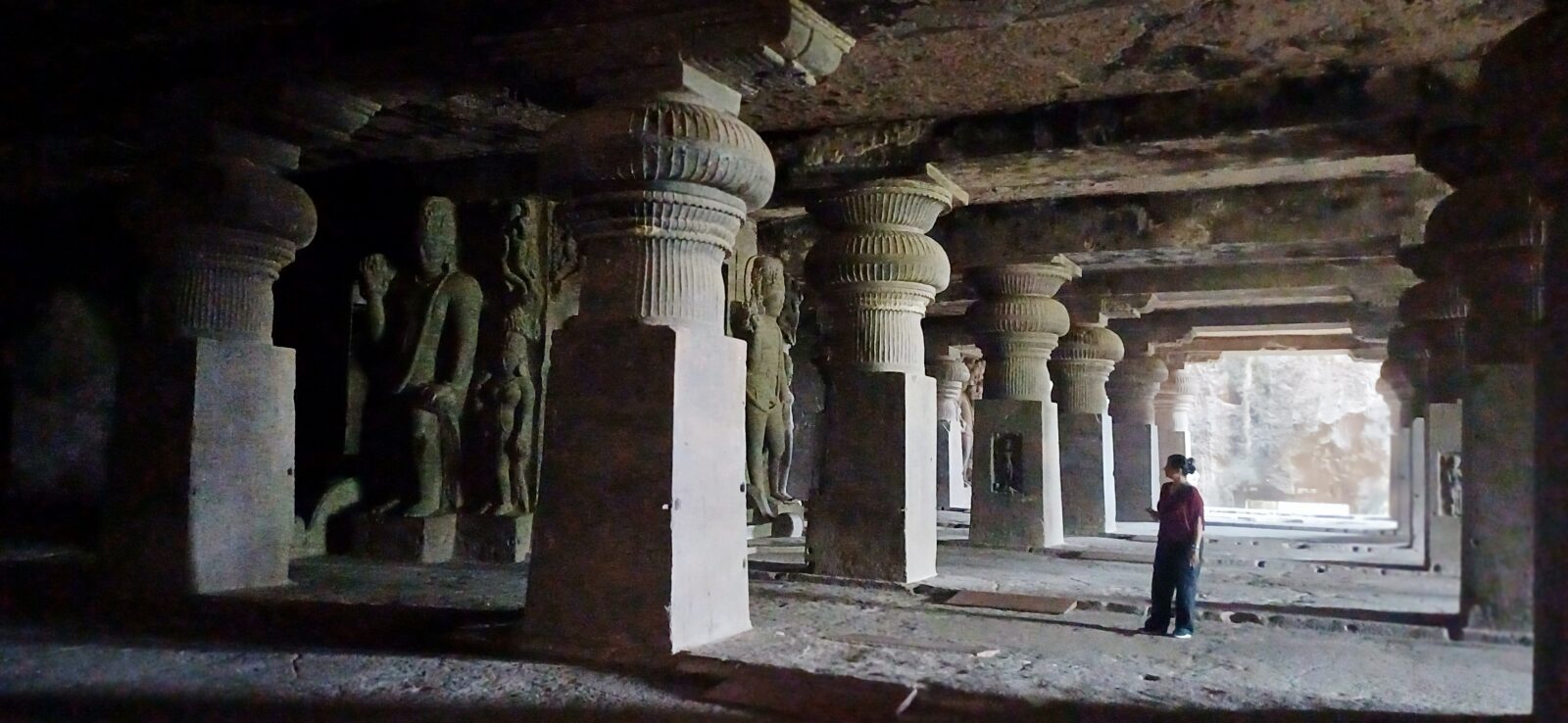
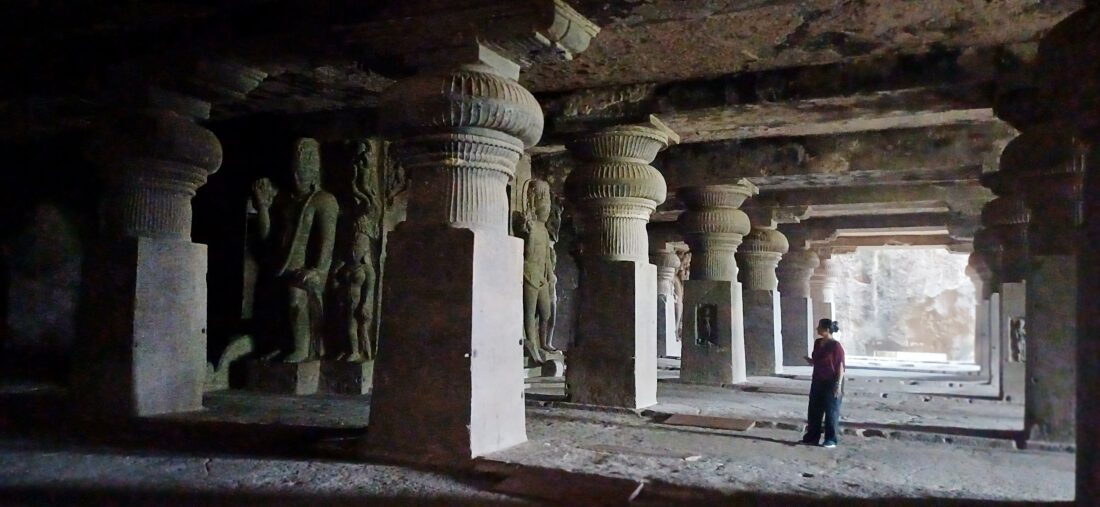
As we entered the main entrance, we stepped into a courtyard with a temple in the centre. Skirting that we entered into the prayer area. The double storied cave, an architectural marvel in itself. The garbagriha houses remarkably well preserved fresco depicting the 11th Tirthankar in bold reds and greens. The frescos are said to be preserved in their original form. The fact that the interiors are in complete darkness may have helped in preserving their original form.
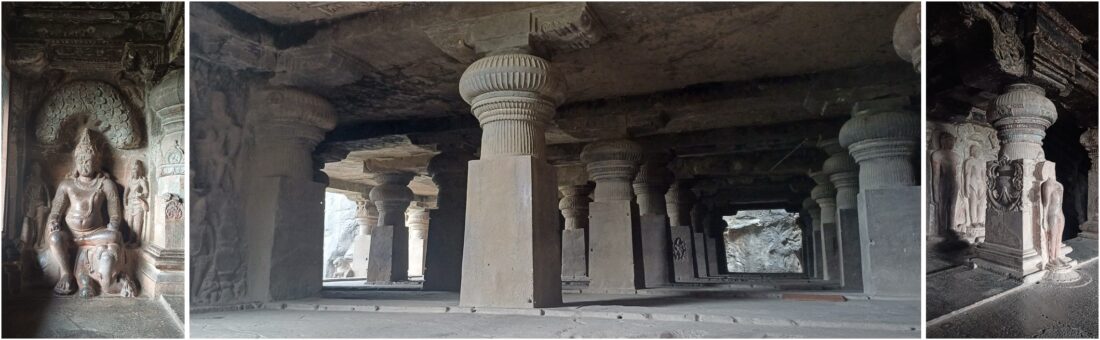
A garbagriha, for the uninitiated, is the innermost chamber in a temple. The word garba comes from the Sanskrit word for womb and Griha comes from the Sanskrit word for house. In the context of Indian temple architecture, it refers to the idea of a “cosmic womb” – the birthplace of the cosmos and of all existence. This is the chamber in a temple where the deity is housed.
The ceiling of the mandap, depicts the stories of the blind queen and other symbols from Jain teachings. The mandap is the area outside or in front of the garbagriha where people gather to pray or conduct yagnas. The mandapa walls of cave 33 are adorned with images of Mahavir, Parsvanath and Gomta from the Jain sect. The figures are made in elegant lines and with a sophistication that only comes with extremely evolved understanding of the craft and subject. The refined carvings spoke of skill and expertise beyond comprehension. It did make me wonder about the amount of practice hours an artist at the time was allowed to work on these caves, and where were those practice pieces to be found.
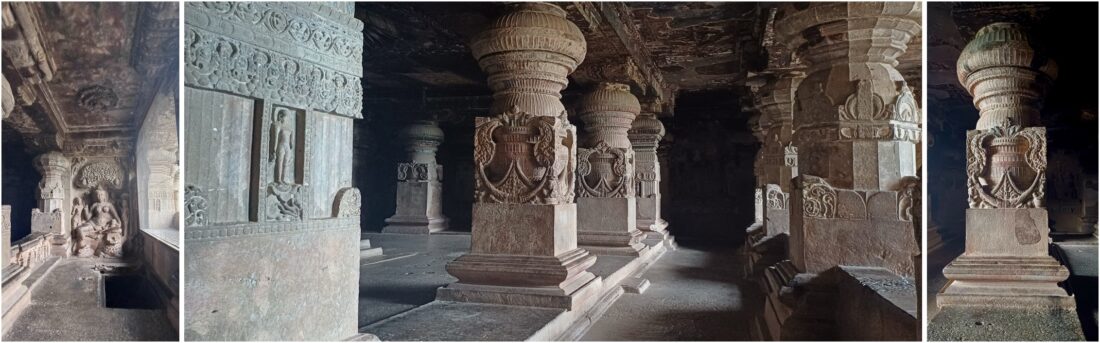
The first floor of the cave holds magnificent, larger than life relief sculptures of yaksha and yakshi, but what caught my attention the most was the unusual design of the pillars. The layered carvings on the pillars, depicting draped cloth along with floral motifs and ribbed multiple-layered top, exhibit immense expertise. It’s almost like the sculptors are showing off their incredible skill with a cool confidence and panache! The flourish of the pillars juxtaposed with the clean and elegant lines of the Jain figures around the columns, seem to highlight the act of renouncing worldly temptations.
It was an inspiring start to the day to witness the exquisite beauty created centuries ago. The size and scale of the cave and the sculptures within, left a sense of being one with our surroundings. It felt like we were occupying the remaining negative space to complete the sculptures around us – the viewer and the viewed as one.
Moving onward to cave 29, we decided to take a short-cut and walked through a narrow cemented path surrounded by fresh green grass. The path was slightly elevated and beyond the trees, one could see hints of the town. We soon arrived at cave 29 and its exterior certainly did not prepare us for what lay within. Dedicated to Lord Shiva, this rock-cut Ellora cave is also known as Sita ki Nahani. The first thing that struck me as I stepped into the cave was the sheer scale of its interiors. Is it even possible to achieve such a feat in cave architecture I wondered!
Dating back to the 6th century, it’s in stark contrast to cave 33. Perhaps it’s the immediate juxtaposition of these scales that adds to the awe inspiring magnitude of its space. Where cave 33 has a lower ceiling, the height of cave 29 is approximately 18 ft. The scale of
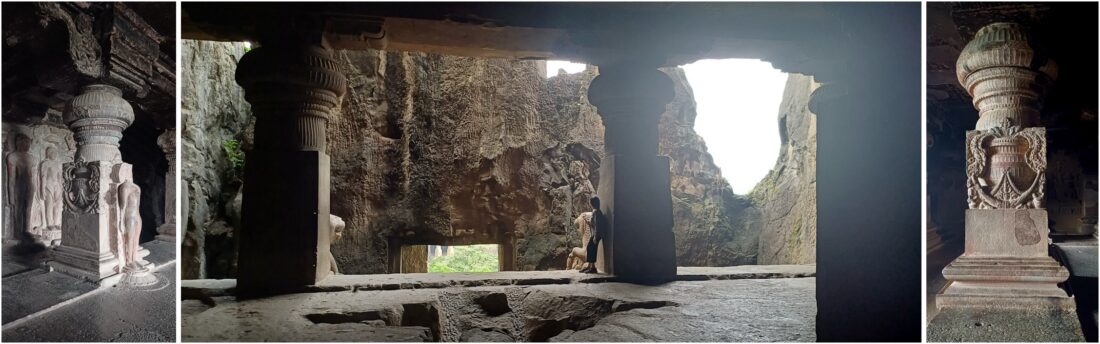
the sculptures is designed to fill you with awe and make you realise how small and insignificant humans are in the grander scheme of things. The clean lines of the pillars and their height accentuates the austere and simple aesthetics.
Upon stepping into the cave, I saw a beautiful larger than life depiction of Ravan lifting Mount Kailash on the right wall. The classical and sophisticated depiction of the human form with economical and elegant lines is a theme that runs through all the sculptures in the cave. As you walk deeper into the cave, you can see that the natural formation of the structure gives it the most unique ambience. There’s a natural opening in the left wing through which the morning light filters in, thereby adding mystery to the already awe inspiring interiors.
Gazing in wonder at the mystical light beam falling on the lion’s head, isn’t enough to set the mood, it began to drizzle. A soft natural light filled the cave and the right wing of the cave opened up to the horse-shoe shaped valley. The lush green landscape of Maharashtra was in its full monsoon glory and you could see a narrow path going down to a cluster of caves with many small waterfalls covering their opening.
Of course, we immediately wanted to walk down to the cluster to see the interesting amalgamation of nature and structure. But the door was locked and we were forced to stop our exploration from going any further. So, we walked back to the end of the central axis to the garbagriha. The shivling, silent and astute in its meditative form, exuded an omnipresent energy that filled you with an overwhelming awareness of the vastness and all-pervading divine energy.
That is the power of architecture! It can make you experience the spiritual by creating an awareness of the self. Be it through the Jain philosophy of being one with the world and therefore not hurting any life form, or through making you aware of your own insignificance in this vast cosmos.
That June morning, I had walked into the temple cave complex to look at art and perhaps enjoy the stories depicted in its caves, but what I came back with was an acute spiritual experience – an awakening of the senses. It renewed my awe and admiration for these magnificent group of cave temples, forever imprinting them on my mind.

Malvika Mankotia
Malvika Mankotia is a versatile artist having earned her B.V.A. and M.V.A. from the Faculty of Fine Art, M.S. University, Vadodara. Her work has been featured in prominent national and international exhibitions, including the International Watercolor Festival in Italy (2024) and the Confluence Awadh Art Festival in New Delhi (2022). A recipient of the silver medal at the National Art & Science Exhibition (2021), she has also participated in numerous residencies and workshops, contributing to the art community . Her artistic journey is marked by experimentation, community engagement, and a commitment to creating impactful work.