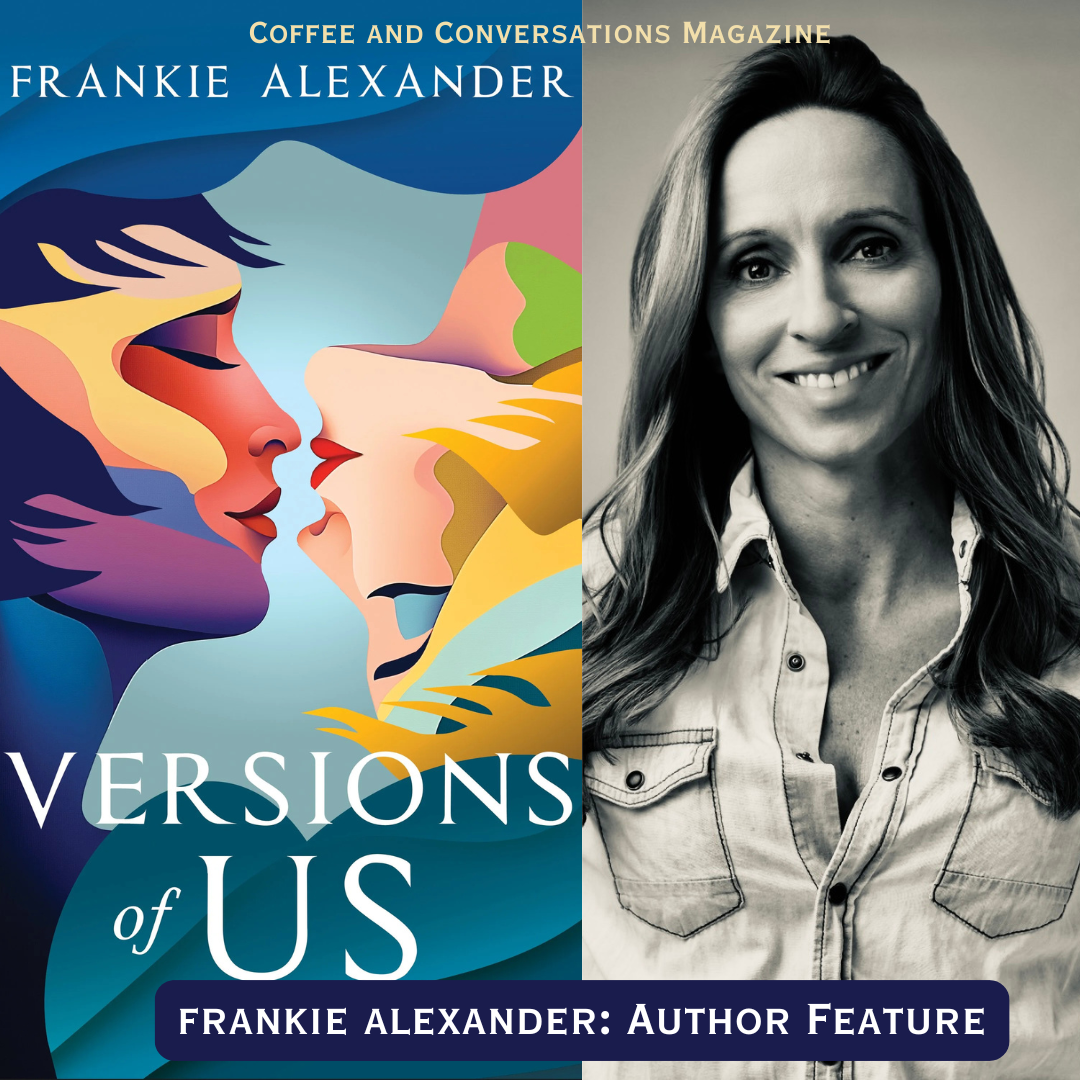

Anyone who knows me knows that romance novels are my literary comfort food. So imagine my delight when, earlier this year, I discovered that a fellow member of the Hong Kong Women in Publishing Society was about to release her very first novel, and it was a romance set right here in Hong Kong.
Versions of Us is a contemporary sapphic romance that weaves together themes of identity, ambition, desire, and the possibility of reinvention. Written by Frankie Alexander (the pen name of Hong Kong-based author Imogen Short), the novel delves into the rawness of vulnerability and the courage it takes to be truly seen and to fall in love.
Charlie and Sienna leap off the page as intelligent, ambitious, and wonderfully layered characters, each carrying the weight of their own histories. I was especially delighted to find two of my favourite tropes—rivals to lovers and forced close proximity—woven seamlessly into their story. If you crave a story that balances genuine, real-life complexities with a swoonworthy romance and sparks with undeniable chemistry, this novel is for you.
It is an absolute pleasure to interview Frankie on the release of her fantastic debut romance.
Frankie, can you take us back to the spark that ignited this fast-paced sapphic romance? What moments or inspirations set this story in motion?
It was always destined to be a romance, but that’s never how I thought about it when I started writing. I was fascinated by identity and how certain experiences can trigger an evolution in our sense of self, almost like a shock that rearranges the system. What does it mean to be one person and then suddenly feel like you’re someone else? And what role can other people play in helping us navigate that?
That’s where I had so much fun writing Sienna and Charlie. They’re both carrying wounds from things that have happened to them, and when they clash, it’s their defence mechanisms coming up against each other in quite a catastrophic way. But as they begin to see what’s beneath all that, they start to understand each other and, perhaps more importantly, themselves.
I LOVE the psychology of that. The idea that love can create enough safety to let someone see the parts of ourselves we’ve spent years protecting. And romance is such an interesting genre to explore that in, because you get to watch two people slowly dismantle everything they thought they knew about themselves.
Talk to us about setting the novel in Hong Kong. Was there a specific reason behind this decision? I especially enjoyed how the city’s energy mirrors Sienna and Charlie’s inner emotional lives.
I’ve lived in Hong Kong for over a decade and it still manages to surprise me. I lived in Wan Chai first, which was a sensory overload. Happy hour, wet markets, Lockhart Road. The old and new sitting so casually, and sometimes contradictorily, alongside each other. Now I live in Pui O, which is like a dream. Birdsong, mountains and beach.
And Hong Kong offers everything between those two extremes. For me, it’s a place where reinvention feels almost expected. One day it gives you room to breathe, and the next it can feel as though the whole city is closing in on you. I’m not sure there are many places quite like it.
So it felt like a natural setting for two characters who are struggling to find their way through something. Hong Kong’s transience is part of what makes it fascinating, but it can also leave people feeling disconnected. People are constantly arriving, leaving, starting over, becoming someone new. There’s something about that which lends itself to a story about identity and belonging.
My next book is set in London and the one after that in Australia. I love writing about places I’ve lived, and being able to sit in the exact spot I’m writing about. Yes, I spent many an evening on Peel Street and drinking wine on my rooftop, where a couple of the scenes are set. It’s a rather good excuse for research, and it helps me capture all the little things that make a place feel real.
Which romance or relationship trope (e.g., forced proximity, enemies-to-lovers, second-chance, fake dating) are you personally drawn to, and which trope did you have the most fun exploring in your novel?
I’ve always been a sucker for enemies-to-lovers. There’s something fascinating about an immediate, visceral reaction to another person. Why does this particular person get under your skin? What are they triggering that you might not even understand yourself?
And how can someone go from meaning so little to meaning everything? Or, when things go wrong, the other way around? It almost becomes existential. (Disclaimer: everything becomes existential with me.)
I also love the tension of two people who are completely wrong about each other. There’s so much room for humour in that, especially when the reader can see exactly what’s happening long before either character is prepared to admit it. Sienna and Charlie gave me plenty of opportunities to have fun with that.
Do any of the characters, Charlie or Sienna, in Versions of Us, reflect pieces of your own journey and experiences? Where do your life and your fiction intertwine?
I get quite a few questions about whether the book is autobiographical, and I suspect people are asking about the romance side, haha. But the journeys both women go through draw on experiences I’ve had in my own life, and I wanted to bring some of that into the story.
What I hadn’t anticipated was how many people would recognise parts of their own experiences in the characters. I’ve had people come up to me and talk about frustrations with their health, or about the way someone treated them years ago and how that’s stayed with them. Sometimes they’ll tell me something deeply personal, which is an enormous privilege. They’re fictional characters, but people are recognising something real in them.
I think we all carry around versions of ourselves that other people have created for us, or that we’ve created to get through certain experiences. Sometimes it takes years to work out which parts are really us, and even longer to part ways with the ones that no longer serve us. That’s something I recognise in both Sienna and Charlie, although they deal with it in completely different ways.
I read a powerful quote from Alexander Leon in 2020 that’s stayed with me ever since:
“Queer people don’t grow up as ourselves, we grow up playing a version of ourselves that sacrifices authenticity to minimise humiliation & prejudice. The massive task of our adult lives is to unpick which parts of ourselves are truly us & which parts we’ve created to protect us.”
It blew my mind at the time because I’d never seen the tension between who we are and who we learn to be articulated quite so clearly. I certainly recognised it in myself, and I think it resonates with anyone who’s ever felt they had to mask or hide parts of who they were growing up. For Sienna and Charlie, their struggles aren’t centred on their sexuality, but they’re both hiding parts of themselves to avoid being hurt again.

Your novel dives into very timely issues such as ethics in technology and data sharing, and challenges of the public medical system. What compelled you to weave these real-world concerns into your story?
I enjoy exploring real-world issues through fiction, especially when there isn’t an obvious right answer. Data privacy is something we’re all becoming more conscious of, but I was interested in what happens when the benefits of sharing that information start to outweigh the risks.
For Charlie, who’s spent so long trying to understand what’s happening to her body, the possibility of finally getting answers is incredibly tempting. And I think that’s quite human. We all have principles about privacy until we’re faced with something that makes us reconsider them.
The healthcare side is personal to me. I have enormous respect for healthcare systems, especially having grown up with the NHS in the UK, but I also know what it’s like to feel you’ve fallen through the gaps. When you’re dealing with serious illness, those experiences can reach into every part of your life. They can fundamentally change your relationship with your body and your sense of control.
My next novel explores something equally topical (no spoilers), with potentially enormous consequences, and what happens when people find themselves trapped within a story that’s not of their own making. It’s a lovers-to-rivals-to-lovers story, which has been super fun to write.
At its heart, your novel explores identity and the art of reinvention, especially after life-altering events, and falling in love under the most unexpected circumstances. Was it difficult to weave these powerful themes into a romance novel? Can you talk about balancing sexual friction and chemistry between characters with these strong themes?
I think the chemistry comes from the gradual surrender to each other. So many people, women especially, spend years holding everything together, managing how they’re perceived and keeping certain parts of themselves carefully hidden. Then someone comes along who notices what everyone else has missed. I find that incredibly intimate.
And I love writing the physical side of romance because once you’ve established that emotional connection, the attraction becomes much more interesting. There’s all that tension between wanting someone and being terrified of what it might mean to let them close. Especially with two women like Sienna and Charlie, who’ve become accomplished at keeping people at a distance.
That’s why I enjoy a slow burn. Those little moments when the characters are desperately trying to stay in control, while their bodies are telling them something completely different. Sometimes a look or an accidental touch can carry more tension than anything explicitly sexual… although I do enjoy writing those scenes too 😉
You published this book with Ylva Publishing, a powerhouse in queer fiction. How has the journey been from a draft on your laptop to a published book? Which sapphic or queer authors have most influenced your writing style?
The journey has been long and fraught with rejection. I naively thought writing the book would be the biggest milestone. Then came pitching, taking feedback, getting rejected and trying to find the right publisher.
When I sent the manuscript to Ylva, it felt like a moment of coming home. Astrid, the MD, set up a call within a week and I knew almost immediately that the book (and hopefully many more) had found its home.
Of course, finding a publisher was the beginning of a whole new adventure: editing, cover design, marketing, reviews. I had no idea how much work went into getting a manuscript into someone’s hands. Seeing Versions of Us on bookshelves in Hong Kong has been quite surreal. And we’re having the Hong Kong launch at Bookazine in Landmark on 11 November, which I’m sure will make it feel very real!
As for writers, I read across all sorts of genres. I love Casey McQuiston, Alexandria Bellefleur, and Taylor Jenkins Reid. I’m interested in authors who create characters you can love while recognising they’re perfectly capable of making a spectacular mess of their own lives.
You write fiction as Frankie Alexander, while your forthcoming non-fiction book, The Narrative Gap, will be published under your own name, Imogen Short. What prompted you to use a pen name, and does writing under different identities influence your creative process?
I want to write lots of books across different genres, and they’ll probably appeal to quite different audiences, so I like giving them their own identities. I’ve also got a dystopian novel with a small US publisher, which will probably need a different name again (it’s SO different from the romance novels). Otherwise, my author back catalogue could get confusing very quickly.
And there’s a personal side too. A pen name gives me a bit more freedom to get creatively wild if I want to, and it creates a nice separation from my professional work and the academic book with Routledge, which will be under my own name. Just don’t ask me how on earth I show up to the in-person book launch in November as both Imogen and Frankie 🙂
Writing across genres has also been a fascinating learning experience. I’m becoming much more conscious of what readers expect from a genre, where those expectations come from, and how far I can push them.
For instance, in queer romance, a happily-ever-after is a pretty fundamental expectation. In dystopian fiction, all bets are off. I’ve loved playing with the unease you can create when readers have no idea where the story might take them. By the time you finish my dystopian novel, I suspect you’ll want to throw it at a wall.

R – The Archie Hut 2 Hut 5km race in Australia: My first 50km after knee surgery… I came 9th female overall but lost seven toenails and injured both shins in the process.
Talk to us a little about The Impact Collective? Can you share any transformations you’ve personally observed in participants who have taken part in the various Impact events?
Sport has been a huge part of my life since I was little. I have an identical twin sister who lives in Australia, and she’s now competing at a seriously high level in trail running and HYROX. I’m incredibly proud of her, and one of our favourite things to do together is run or hike in the mountains, or crew each other at races around the world.
I recognise what a privilege that is, and I know it’s not the same for everyone. So The Impact Collective came about from an idea between four of us, Jemma, Kate, Ziggy and me, to give more women the chance to experience what sport can bring to their lives, whether they’re trying something for the first time or finding their way back to it.
We held our second She Races event in October, and the feedback floored me. We had women from 33 different nationalities, a 91-year-old participant and mums running with their babies. One woman told us it was her first race while pregnant and how proud she felt. Another shared that her four-year-old son had taken her medals into school the next day to show his classmates. She said how important it was for him to see so many strong women. I loved that because I’d never even considered the impact we might have on the little boys watching their mums.
Then there were the messages from women who told us how emotional the day had been, how welcome they felt and how much it meant to have strangers cheering them on.
You spend months worrying about permits, logistics and whether the weather will hold, and then you get these messages and realise what the day meant to people. I love the thought that someone might leave one of our events thinking differently about what they’re capable of. And that feeling might stay with them long after they’ve crossed the finish line.
What’s next for you, both as Frankie Alexander and Imogen Short?
My publishing deal with Ylva is a three-book contract, so the next two novels are already underway. I’d love to keep writing and publishing for as long as I can. Two books a year would be the dream, but I do have a full-time job to manage too!
With The Narrative Gap coming out next year, I’ll be stepping into a completely different publishing world, and I’m curious to see what that looks like. There’s actually a lot of overlap in the themes I explore in fiction and non-fiction, especially around identity and the stories we tell ourselves and each other. I’m fascinated by how those stories shape what we believe we’re capable of, and what happens when we begin to question them.
I’ve also joined the committee of the Hong Kong Women in Publishing Society, and I’m hoping to give more time to that next year.
And somewhere in between all of that, I’d like to keep running, travelling and spending time with the people I love (and my two dogs, Zeus and Achilles)…although looking at the calendar, I may need to get a bit better at saying no.


ABOUT FRANKIE ALEXANDER
Frankie Alexander is the pen name of Imogen Short, a Hong Kong-based author and storytelling strategist whose work explores identity, ambition and the stories we tell about ourselves.
Her debut novel, Versions of Us, is a contemporary sapphic romance set in Hong Kong, published by Ylva Publishing in September 2026 as part of a three-book deal. Through emotionally complex characters and relationships, her fiction explores what happens when life takes an unexpected turn and people are forced to reconsider who they’ve become.
Alongside her fiction, Imogen is Managing Director, APAC, at Write the Talk, where she specialises in leadership storytelling. Her forthcoming non-fiction book, The Narrative Gap (Routledge, 2027), examines how the stories told about women influence their authority and opportunities at work.
She is also co-founder and Race Director of The Impact Collective, a Hong Kong non-profit creating more opportunities for women to participate in sport, and serves on the committee of the Hong Kong Women in Publishing Society.
Originally from the UK, she has lived and worked in London, Sydney and Hong Kong. She now lives on Lantau Island with her wife and their two dogs, Zeus and Achilles.
Read it… love the way you have questioned Frankie Alexander deeply, yet without being invasive.
Romance books & movies are my comfort food too.
Hi Shikha,
I love that you did this interview as it has proven that a writer can explore deeper issues in the romance genre.